
Menu

UP Tacloban’s Road to CU-hood
by Arvin De Veyra and Patricia Arinto
Establishment
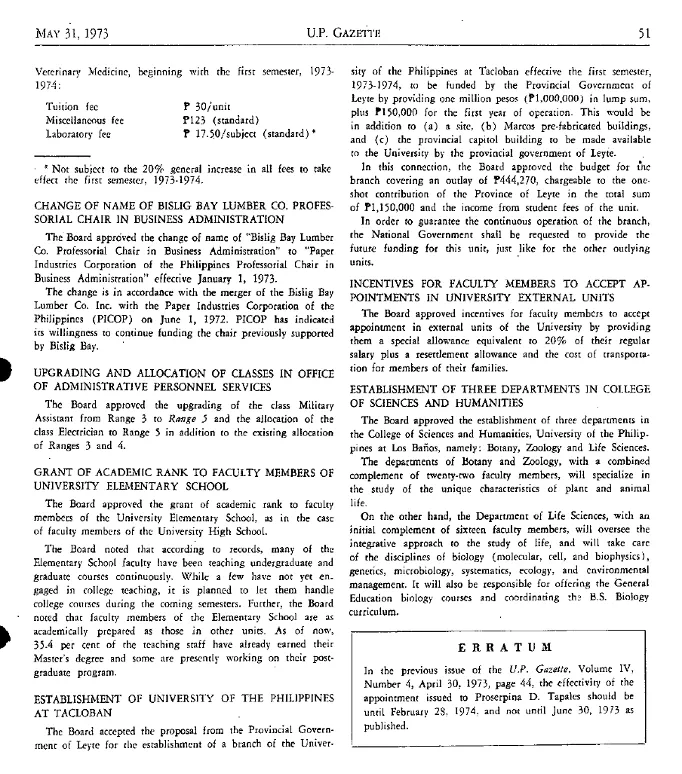
On 23 May 1973, the University of the Philippines (UP) Board of Regents (BOR) at its 833rd meeting approved the establishment of the University of the Philippines at Tacloban as a regional unit. The decision came five years after the Leyte Provincial Board led by then Governor Benjamin T. Romualdez submitted to then UP President Salvador P. Lopez a request, promulgated as Provincial Board Resolution No. 85, for the “opening of a branch of the University of the Philippines in the City of Tacloban.”
The new regional unit had three general objectives: “1) to provide quality education in the Eastern Visayas region and turn out graduates who possess essential attributes for becoming productive and responsible members of the community; 2) to undertake and encourage scientific research… that will help illuminate phenomena [and] serve practical values of resolving problems and enhancing regional development; and 3) to offer technical assistance to… government, business, and the public at-large toward the further improvement of the quality of life in the Eastern Visayas region.”
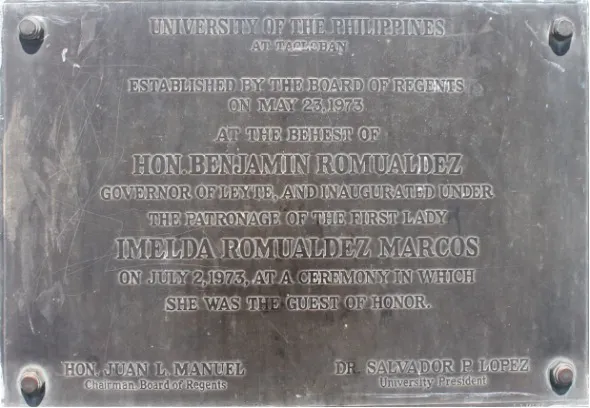
UP Tacloban opened in June 1973 with 141 undergraduate enrollees and seven full-time faculty members holding classes in a small building on a lot behind the old Leyte Provincial Capitol. On 2 July 1973 the college was inaugurated by then President Ferdinand E. Marcos, with then First Lady Imelda R. Marcos as the guest of honor. The event took place on the same day that the San Juanico Bridge was inaugurated and was marked with the installation of a plaque in front of the capitol building.
The new regional unit had three general objectives: “1) to provide quality education in the Eastern Visayas region and turn out graduates who possess essential attributes for becoming productive and responsible members of the community; 2) to undertake and encourage scientific research… that will help illuminate phenomena [and] serve practical values of resolving problems and enhancing regional development; and 3) to offer technical assistance to… government, business, and the public at-large toward the further improvement of the quality of life in the Eastern Visayas region.”
UP Tacloban opened in June 1973 with 141 undergraduate enrollees and seven full-time faculty members holding classes in a small building on a lot behind the old Leyte Provincial Capitol. On 2 July 1973 the college was inaugurated by then President Ferdinand E. Marcos, with then First Lady Imelda R. Marcos as the guest of honor. The event took place on the same day that the San Juanico Bridge was inaugurated and was marked with the installation of a plaque in front of the capitol building.
Integration into UP Visayas
On 23 March 1983, then UP President Edgardo J. Angara issued Executive Order (EO) No. 4 reorganizing the University of the Philippines into a system of autonomous universities, namely, U.P. Diliman, U.P. Los Baños, U.P. Manila, U.P. Visayas, “and others that may be established in the future.” Two years later, U.P. College Tacloban and U.P. College Cebu were placed under the administrative supervision of U.P. Visayas, and the college’s name was changed to UP Visayas Tacloban College. In AY 1985-1986 a comprehensive academic review was undertaken and the four academic program clusters were consolidated into two Divisions — the Division of Arts and Sciences and the Division of Management and Technology.
On 26 November 1998, the BOR during its 1126th meeting approved the reorganization of UPVTC into four academic divisions: Division of Humanities, Division of Social Sciences, Division of Natural Sciences and Mathematics, and Division of Management. By this time the college had 11 undergraduate program offerings — BA (Communication Arts), BA (Social Sciences) Economics, BA (Social Sciences) Political Science, BA (Social Sciences) Psychology, BA (Social Sciences) Sociology, BS (Biology), BS Computer Science, BS Accountancy, and BS Management — and the Master of Management program with specializations in Public Management and Business Management.
Three years earlier, on 24 October 1995, the BOR approved the establishment of the Leyte-Samar Heritage Center as a research and extension unit focusing on studies on various aspects of Leyte-Samar culture and environment. A decade later, the Regional Environmental Information Systems Laboratory was established to collect and provide geospatial information in support of planning and decision-making to address problems related to climate change, disaster response and recovery, and sustainable community development. Furthermore, the MS in Environmental Science program was adopted from UP Los Baños in 2019 and the BS Applied Mathematics program was adopted from UP Visayas in 2022.
Autonomy
On 27 April 2023, on the college’s 50th year, the BOR at its 1380th meeting approved the elevation of UP Tacloban College to an autonomous unit under the Office of the UP President, to enable the unit to better fulfill its mandate in Eastern Visayas and work towards becoming the next constituent university of the UP System.
The college has since revised all of its undergraduate curricula, the BA (Communication Arts) and BA (Economics) programs have been renamed as BA Media Arts and BS Economics, respectively, and a new BA Literature program has been instituted. The BS Accountancy program continues to produce topnotchers in the Certified Public Accountants (CPA) Licensure Examination, including the first and seventh placer in 2023 and the 10th placer in 2024. A graduate of the program had also topped the CPA licensure exams in 1993 and several other graduates had placed in the top 20 passers through the years. The BA Psychology program has likewise produced topnotchers in the Psychometricians Licensure Examination, aside from 100% passing rates.
UP Tacloban’s research and innovation agenda includes biodiversity conservation and environmental protection, Eastern Visayas language and culture, disaster resilience and sustainable development, and community health and well-being. For example, among its most recent projects is the upscaling of glycogen extraction from tahong or green mussels. Glycogen is a key ingredient in cosmetics and pharmaceutical products. The mussel glycogen project, which is co-funded by the Department of Science and Technology’s Philippine Council for Aquatic, Agricultural and Natural Resources Research and Development (PCAAARD) and the UP System, is an innovative response to the problem of harmful algal blooms or red tide, which adversely affects the livelihood of tahong farmers in Region VIII.
Bulwark to the East
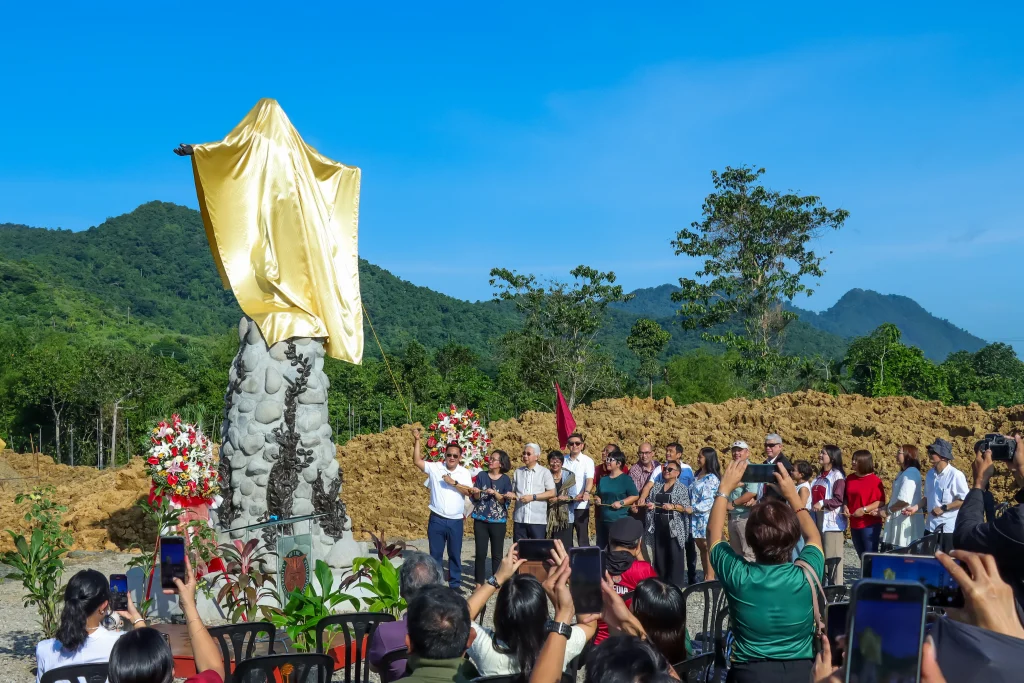
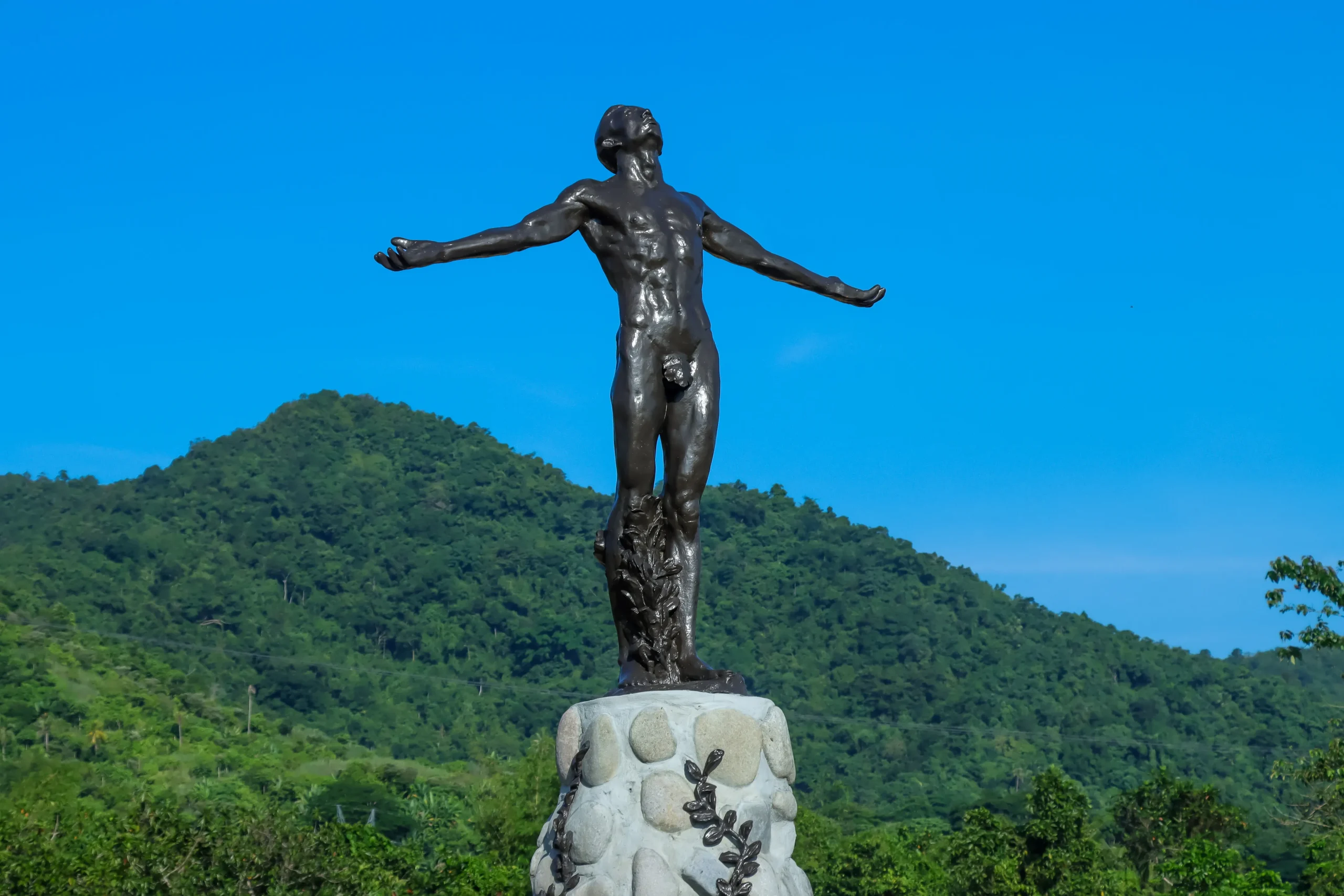
On 2 July 2025, UP President Angelo A. Jimenez and UP Tacloban Dean Patricia B. Arinto led the unveiling of a new Oblation sculpture at UP Tacloban’s Sta. Elena campus in north Tacloban. The ceremony, which was witnessed by BOR members, UP System officials, and UP Tacloban’s faculty, staff, alumni, and institutional partners, was part of the college’s 52nd anniversary celebration with the theme “Pagtukod,” meaning “to build.”
In his keynote message, President Jimenez declared that the installation of the Oblation at UP Tacloban’s Sta. Elena campus represents a promise that “this university that we are building here is consecrated towards the further development of the Eastern Visayas region as a bulwark to the east.”
Indeed, UP Tacloban is committed to building capacities and engaging communities in the sustainable development of Eastern Visayas. It is expanding its curricular offerings, reaching out to underserved communities, undertaking groundbreaking research, and strengthening institutional partnerships and networks to address regional needs and priorities. In line with the BOR-approved UP Tacloban Land Use Development and Infrastructure Plan for 2021-2030, construction of the Administration, Innovation, and Research (AIR) Building in Sta. Elena is ongoing, detailed plans for the first academic building and student dormitory in the new campus are being completed, and, with funding from the UP System, the college has built the country’s first mussel glycogen production facility in the envisioned UP Tacloban Science and Technology Park in Sta. Elena. All these in preparation for becoming UP’s ninth constituent university, uniquely positioned as “UP’s easternmost station” with a mandate to assist in the development of the Eastern Visayas region and the Philippines as a whole.