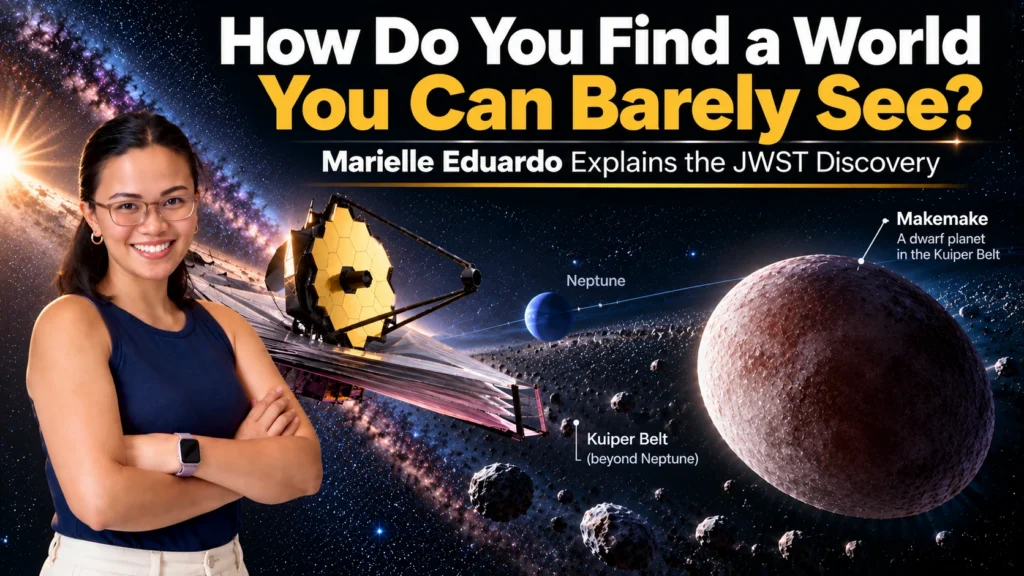
Marielle Eduardo, an alumna of UP Baguio, has authored two landmark papers on finding trans-Neptunian objects (TNOs) or “tiny worlds” in space. The papers are a result of collaborative work between Canada and the US (NASA) based on the James Webb Space Telescope (JWST).
Eduardo is a 2018 BS Physics graduate of UP Baguio, and currently a Ph.D. Candidate at the University of Victoria. She is the first author of a study that uses observations from the JWST to search for elusive worlds.
The James Webb Space Telescope, Eduardo said, “is the most powerful telescope we have right now in the world. If you are familiar with the Hubble telescope, it orbits around the Earth, itong James Webb, it is a bit farther. It is around 1.5 million miles away.”
Eduardo, together with her collaborators in Canada and the United States, published two companion papers based on their James Webb Space Telescope (JWST) and Hubble Space Telescope (HST) observing programs. Using both space telescopes simultaneously, these programs surveyed trans-Neptunian objects (TNOs), measured their colors and light curves, and ultimately carried out the deepest survey of these bodies ever conducted, surpassing the previous record by a significant margin.
Marielle is the lead author of one of the papers. This paper is the primary science paper from the project, using the JWST survey data to infer properties of the planet formation process in the outer Solar System. The companion paper, of which she is the second author, focuses on the shapes and surface compositions of these objects using the combined HST and JWST data.
These papers represent the culmination of several years of work and provide important new insights into the formation of the outer Solar System and the physical properties of these distant objects. Most significantly, the unprecedented depth and scope of these observations have allowed us to place meaningful observational constraints on models of planet formation, offering new tests of how planetary systems formed and evolved.
Last week, NASA announced the publication of the companion papers in a story posted on their website.
To learn more about Marielle Eduardo and her work, Prof. Ian Jasper Agulo of the College of Science and Machine Intelligence and Neural Dynamics Laboratory (MIND Lab) research facility at UP Baguio interviewed her in his Youtube page Eureka Moment.