
UP ESPORTS VARSITY TEAM
By Shireen Co
The UP Esports Varsity Team debuted in August 2024 at the inaugural esports tournament of UAAP Season 86, competing in three titles: first-person shooter VALORANT for PC, multiplayer online battle arena Mobile Legends: Bang Bang for mobile, and sports simulation NBA 2K for console. As of S88, the team has won four bronze medals across titles. Three seasons in, UP EVT is gearing up to thrive.
Built from Scratch
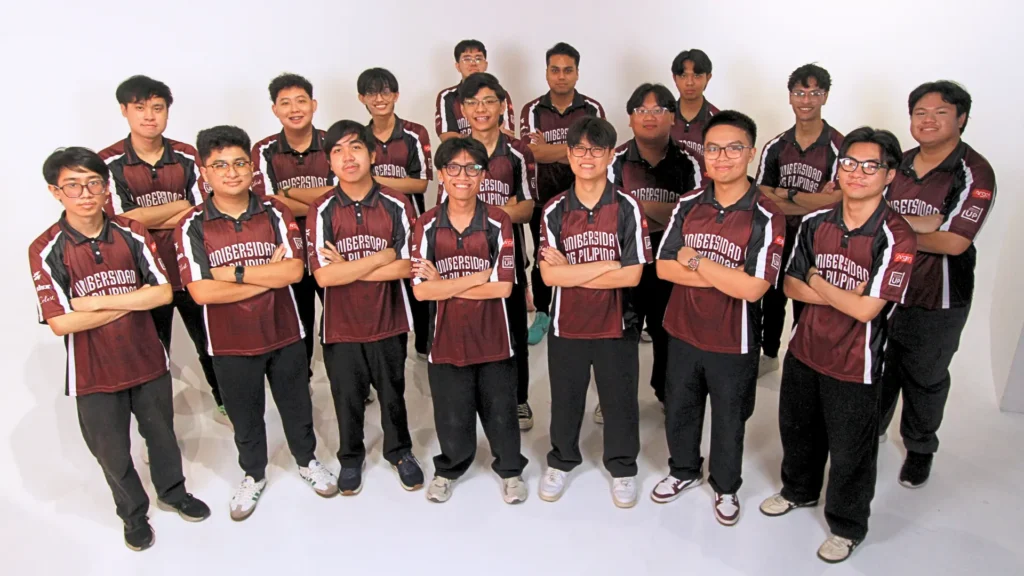
UP EVT is built from the ground up by its charter members, all of whom are part of the UP Diliman student body. The team was formed in response to the addition of esports as a special event in UAAP S86, answering the university’s call for official varsity representation. A skeletal structure of talented players were then gathered, slowly expanding every year. S86 was used to test training and internal structuring, S87 for media push, S88 for more physical events. All operations fall on their shoulders, from scouting by word of mouth, hiring professional coaches, and figuring out marketing and sponsorship strategies. “We really had [only] ourselves during the early stages of EVT,” recounts former VALORANT Captain and current assistant coach Anton Somera. Esports as a varsity endeavor is still largely uncharted, and as such, there is no preexisting playbook; the members of EVT are defining what it means to represent the University as they go. “Right now, esports still has a complicated identity in the eyes of others. We are trying to break that cycle at a university-wide scale so that people will understand what we can bring to the table as a representative of the Fighting Maroons.”
But being young and new spurs them to strive for excellence. Having something to prove works to their advantage, even as they encounter technical, social, and institutional challenges along the way. “We wanted to gain experience, but at the same time, we wanted to make EVT known and establish our presence in the esports community,” says MLBB player Kin Martinez. On the community’s misconceptions, he says, “I think the best way to overcome [the perception that esports is just a hobby] isn’t by arguing with people, but by showing through our actions that we take it seriously.”
Nathan Danac, S86 VALORANT team leader recalls how his parents were wary of the idea of “gaming” at the start. “Understandably, [they] viewed it as a disturbance to my studies.” Director Zoe Soliva corroborates, “[It was] the typical scenario of ‘kaka-computer mo yan!’ and players hiding the fact that they were practicing from their families.” But this is where the intentionality of the team and its leadership rises to the challenge of shifting perceptions. “This motivated me to reach out to parents and also market our team well for them to recognise the value and exposure this sport was giving to their children,” says Soliva. Danac’s parents came around. “At that point, they were already supportive and even bought me a PC so I could have better opportunities in esports,” he says.
Beyond the home, institutional support is still also largely lacking. Traditionally, UP recruits varsity players under VAAS, a system that admits athletes to the university and commits them to serve their sports team for 4-5 years. Without the support and reach of this system, balancing commitment to the team with other obligations becomes difficult. Soliva says, “Keep[ing] people motivated, committed, and focused on EVT work when they have other commitments and aren’t technically obligated to prioritize us [remains a challenge].” Danac acknowledges the support from the UP Office for Athletics and Sports Development, and Nowhere to Go But UP, an alumni foundation. “[But] there was definitely a learning curve for everyone involved on how esports works, and what kind of support they would need to provide to best enable our team.”
The discipline and commitment required to advance video games into the varsity level is no different from the discipline and structure of athletic training, and the fruits of it are the same: both outward skill and the character built by the responsibility and pride of representing something greater than the self. “I see the hunger, not just in the players, but in our managers and staff too, to push ourselves and succeed,” says Danac. Soliva continues, ”I constantly asked myself how to reconcile video games and varsity work – how to convert this recreational hobby into a productive activity […] and to build a culture where people carry a drive to win.”
Team Trust
EVT is made up of three rosters. Each has their own coaches, leaders, culture, and practices, as the demands of each game are different. “Our only common and baseline expectation for the rosters is to treat each other with respect, always make decisions as a team, and be committed and accountable when attending training,” says Soliva. “Other than that, we let their individualities fly as confidence and self-expression does help a player perform.”
A training session is typically conducted online at home, scrimmaging with other university or professional teams. Game footage is then reviewed and discussed by the coaches and members. Areas of improvement are addressed, and creative solutions are pulled from different fields beyond esports or gaming.
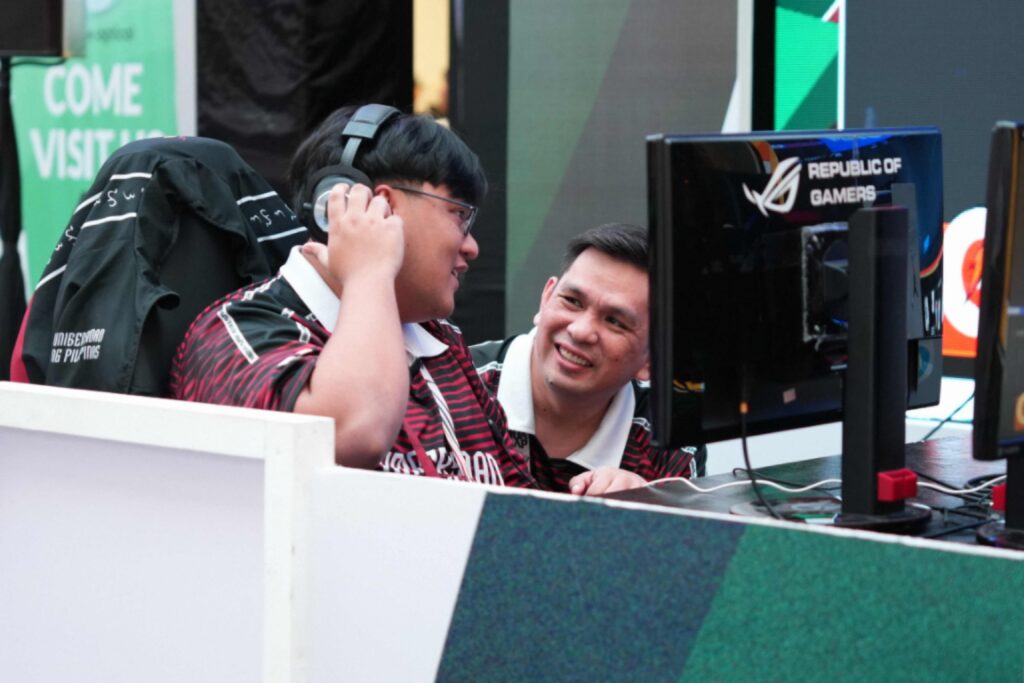
NBA 2K Coach Al Timajo guides the players to bridge the gap between real-life basketball knowledge and gameplay. “I taught the players how to utilize effective meta tactics, introduced core basketball plays, and helped them familiarize themselves with the top-tier NBA teams in the competitive meta,” he says.
Danac, regarding the time he led the VALORANT team, says, “I spent less time improving my individual abilities compared to my teammates. I used the time to review professional matches, expand our playbook, and improve our tactical depth as a team.” Somera shares this sentiment, saying, “Leading is always a massive responsibility, you are the heart of the team’s morale and their shield to any mental strain that can cause the game to go the other way.” Coach Timajo continues, “EVT has refined my coaching philosophy, helping me adapt my leadership style to effectively guide players from diverse backgrounds and personalities.”
The teams are mindful of workload, decreasing training around exam week and increasing it when academic demands are light. Knowing when to pause is also important. “Playing more isn’t always equivalent to improving more. Sometimes you reach a point where your decision-making and concentration start getting worse. Coming back with a clear mind can be much more productive than forcing yourself to continue playing,” Martinez says.
“I saw the potential in the team and wanted to extract it,” says Soliva, confident in the team but prioritizing its health. “I focused more on ensuring our internals were secure, productive, and conducive before turning outwards.” EVT is marked by a strong bond, trust in the leadership, on each other, and on the self, allowing them to weather difficult seasons, losses, and criticism. Tenacity enables them to view each loss objectively, understanding what went wrong, and identifying the technical adjustments required. Danac shares, “I’m thankful for the brotherhood I’ve built with my teammates. Our support and unshakable belief in one another is how we’ve always been able to bounce back stronger.”
Besides trust in each other, the team shares a faith in God. The members share how they always open games and even training sessions with a unified prayer. “It’s something that helps us calm down. It reminds us that we’re going into the game together as a team and it strengthens our bond beyond just playing MLBB,” says Martinez.
Fighting Maroons
The MLBB tournament in the recent S88 is especially meaningful. “Leading up to the season a lot were criticizing saying, ‘Enjoy getting 8th again sa UAAP,’” says Soliva, the comments referring to the previous year’s loss. But the team kept their heads down. “They didn’t know the preparations we were making to improve, so the hate was just noise to me.”
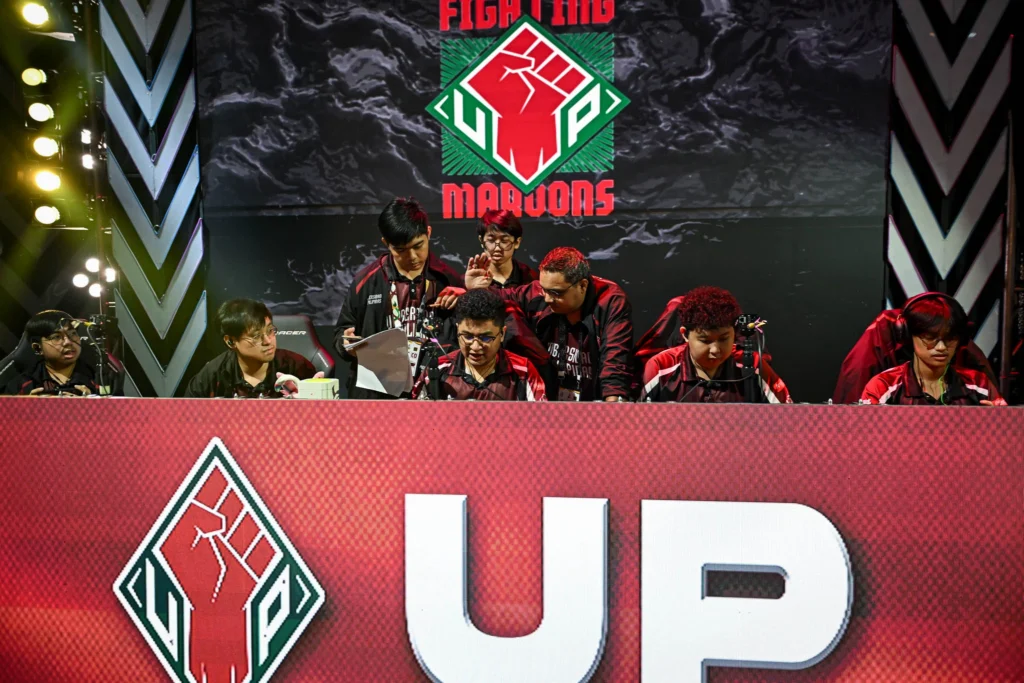
On August 24, 2026, the team filed into the hall for Game 1 against the Ateneo Blue Eagles. They took their seats on stage, excitement ramping up as each player selected their hero. The match started slowly, Ateneo already warmed up and pressured to win, coming from an earlier loss against the Adamson Soaring Falcons. Martinez says, “We were behind for most of the early to mid game, and it looked like we were in a difficult position.” But they continued playing with patience and precision. “MLBB requires a lot of adaptation during a match. The game can change very quickly, so we have to make decisions based on what is happening rather than simply following a predetermined plan.”
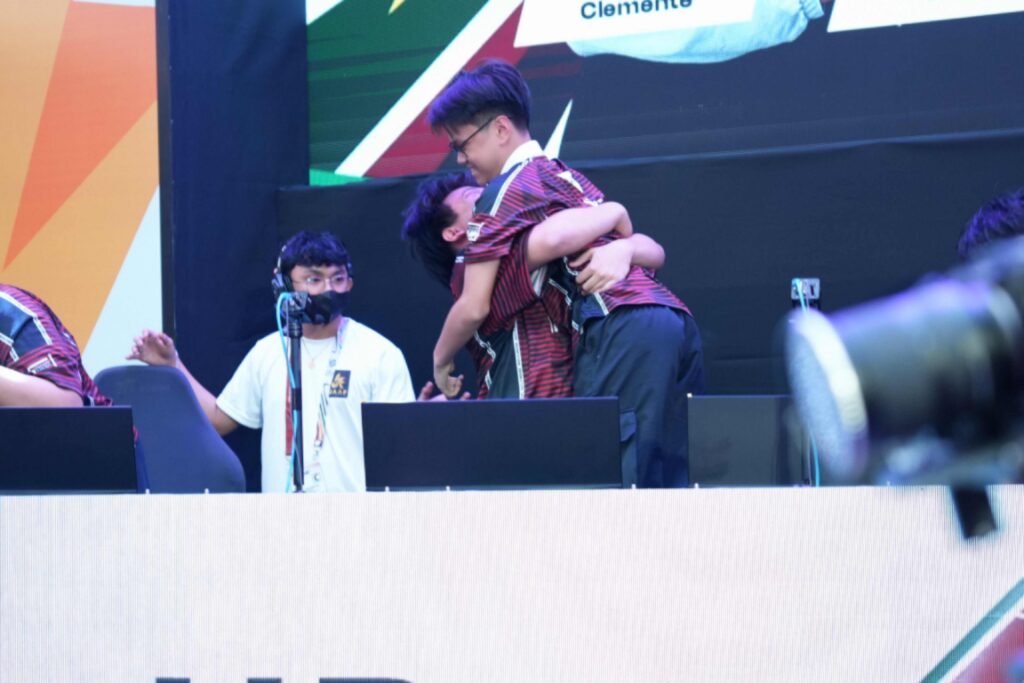
The game began to turn past the midpoint, the team slowly making up lost ground and closing the gap in advantage, pressing the opponent. “Eventually, we found opportunities to turn the game around and make a comeback to win!” says Martinez. The hard work paid off. From this Game 1, the UP Fighting Maroons went on to take the bronze medal overall.
Bearing the name of UP is more than bearing the name of the institution; it bears the names of the athletes, coaches, student body, professors, alumni, and communities. “As players, we’re not only representing ourselves, we’re representing UP,” says Martinez. Rather than being an isolating activity, gaming has the potential to bring these diverse groups of people together. “It gives students a sense of belonging and something to work toward together.” They found support not just in the video gaming community, but also in the traditional sports community and other varsity teams. “Perhaps it was the shared spirit of competition that bound us together and helped us foster mutual respect,” says Soliva.
“I love UP, and EVT is my way of giving back to the university,” she continues. She finds that the dedication one gives is returned. “It feels weird to say as we technically created this opportunity for ourselves, yet somehow it’s now standing on its own and giving us blessings back.”
There is still so much future ground to cover for EVT. As director, Soliva has many ideas. “I envision growth as us steadily approaching stability both resource-wise and financially,” she says. “My next goal is to set up a training space equipped with PCs. PS5s, phone support, and strong wifi in UP Diliman so that we no longer have to conduct remote trainings at home. I hope for this to be possible within the next 5 years.”
She’s also careful not to overextend the team, keeping it to only essential membership and staff, in order to maintain focus and care. Instead of expansion, she’s looking to work alongside other esports varsities, acknowledging the older and longer-established varsities of UPLB and UP Cebu. “It would be nice if there were opportunities for us to collaborate.”
“What I’ve stood for since the start is for UP EVT to be a team that supports, uplifts, enables, and equips its members with the environment, tools, and resources to succeed. As well as being a team that upholds a strong desire to win, and a deep desire to win together.” says Soliva. Idealistic and passionate, UP EVT is hopeful that sports communities and organizations can continue to be made better. As UP Diliman’s youngest varsity, they are full of momentum, running uphill. They follow a long line of tradition while forging their own path, carrying the name of the University over new ground.