


UPCM CLASS 1967 – A CLASS FOR THE AGES
By Teodoro V. Santiago Jr., MD and Angelina de la Cruz-Castro, MD
On June 26, 2026, during Buwan ng Unibersidad, the University of the Philippines (UP) conferred one of the coveted Gawad Pangulo para sa Natatanging Alumni Awards on the UP College of Medicine (UPCM) Class 1967. It was the first time that a class in the entire UP System had been so honored, so much so that the nominator first had to make an inquiry to ascertain that a UP class was indeed eligible for this award. What made UPCM Class 1967 so unique among all UP classes as to have deserved this award? A primary reason was that the class loved UP, UPCM, and the Philippine General Hospital (PGH) and never forgot the institutions that made us who we are. Another reason was that the class never compromised on its core values of honesty and integrity. And while we lived our lives independently, we were shaped by shared experiences of tragedy, anger, and triumph. This is our story, and as we approach our Diamond (60th year) Jubilee, it is likely being told for the final time.
120 Lives, One Shared Beginning
We were a class of 120 unique individuals coming from different backgrounds, but it helped that a majority of us took pre-med at UP Diliman. We started a little differently from other UPCM classes in that, in an era of accepted female gender discrimination in UPCM admissions, we graduated more females (45%) than any previous UPCM class. This happened because there were a lot of talented female UPCM applicants in 1962 and, as rumor had it, not enough qualified males. It also didn’t hurt that many of the women were articulate and attractive, so that they stood out during interviews. As will be apparent later, this was not an insignificant occurrence. At UPCM, we were the antithesis of college nerds as we mixed superb medical education with triumphs in intramural athletics (basketball, women’s volleyball, and badminton) and choral competitions. However, as we were finishing our studies, we experienced tragedy quite early. One of us, Augusto Frias, contracted varicella (chickenpox) while working in the pediatric wards at PGH and developed a myriad of complications that caused him to succumb to the disease. It made us realize right then that we practiced a noble but dangerous profession, and that life could be cruelly short.
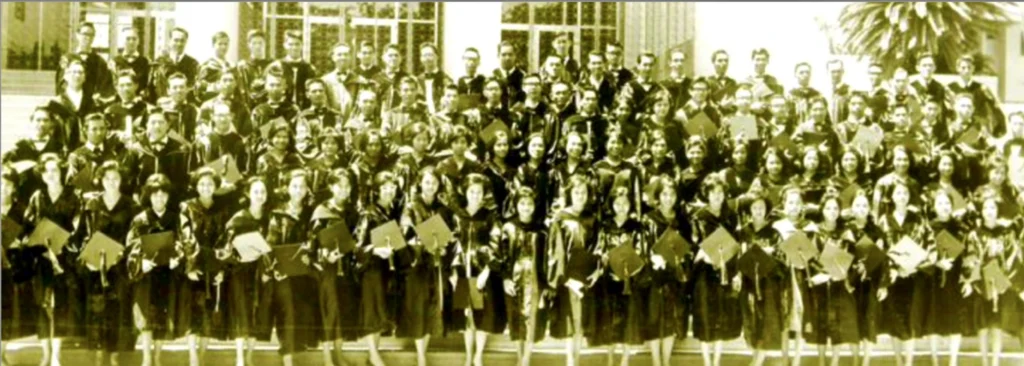
Our First Taste of Tragedy
Shortly after graduation, we also experienced anger when we came face to face with Philippine corruption. Our Philippine licensure board examinations in 1967 were riddled with bulk leakage of questions in Pathology and Pediatrics and were supervised by proctors openly assisting candidates from other schools. Supported by then newly appointed UPCM Dean Dr. Florentino Herrera Jr., the class, led primarily by its vocal women, formally demanded that the whole licensure examination results be annulled. The fact that we had a 100 percent passing mark as a class didn’t matter. This created quite a ruckus that reached the courts and Malacañang. Although the class’s petition for annulment was ultimately denied, it led to limited punishment of the guilty parties and to the exclusion of politician-doctors as test makers. Ironically, the most major accomplishment of that petition was an unintentional one; the numerous female Class 1967 members created quite an impression on Dean Herrera, who marveled at their numbers and at how articulate and impressive they were. The ultimate result was that, starting with the UPCM applicants about to be interviewed at that time (i.e., Class 1972B), an unofficial policy of gender equality took effect, with the end of female gender bias in UPCM admissions eventually becoming a policy that persists to this day.
Following “Moon River” Across the Seas
The class’s unofficial hymn was the song “Moon River,” with the part about having a lot of world to see striking the most responsive chord. The next five years (1967–1972) saw a majority of class members pursuing postgraduate training abroad. Class members were accounted for in every specialty except ENT. Postgraduate training in the USA was rife with professional discrimination, aided and abetted by the American Medical Association, especially against Asian FMGs, who were characterized as being inferior in every aspect to American medical graduates (AMGs). However, Class 1967, confident in its UPCM education and with its battle scars earned earlier, was more than prepared to fight with the American medical establishment to gain its rightful place under this foreign sun. We quietly and competently did the work and took advantage of breaks when they occurred, with a couple of classmates (Carmen Tuazon and Ping Alfelor) using the American court system against their university employers (George Washington and LSU) to successfully curtail illegal discriminatory policies.
Most of us were scheduled to complete our specialty and subspecialty training in 1972. However, as we know, Martial Law was declared in the Philippines that same year. So, instead of going back to the Philippines, a lot of us (encouraged by our worried families back home) decided to linger in the USA to wait until the political atmosphere back home calmed down. Of course, this situation did not conclude until the EDSA Revolution of February 1986, during which class member Helen Agustin was among those holed up with future Philippine President Fidel Ramos and Juan Ponce Enrile at Camp Crame.
Leaving a Mark at Home and Abroad
Staying in the USA meant looking for jobs, which success and family needs eventually made permanent. Looking back, there are numerous indicators of the imprint that the class left on American medicine. Several of us became tenured faculty members in American medical schools (Lina de la Cruz at the University of Pennsylvania, Carmen Tuazon at George Washington, Dina Saga at the University of Florida, Wee Besa at the Medical College of Pennsylvania, Ted Santiago at Rutgers-RWJMS). Two other distinguished medical school professors earned numerous Golden Apple or other teaching awards (Connie Somera in Pediatric Nephrology at Rutgers-NJMS, and Cynthia Umali in Diagnostic Radiology at the University of Massachusetts). Many became successful and sought-after private practitioners in Neurosurgery (Joseph Soliman, Mario Canlas), Urology (Sam Torres, Joe Gonzales), Internal Medicine (Be Lazaro, Joe Pascual, Dione Pastones, Frankie Utzurrum, Gil Ereso, Ching Baquiran, Meg Choa, Ramon Pimentel, Ella Sutton), Cardiology (Nenette Ador Dionisio, Nels Arcega, Pons Salud), Endocrinology (Sanny Enriquez), Gastroenterology (Bayani Manalo, Rolly Sineneng, Teng Beng Go, Joe Nepomuceno, Gel Cruz), Hematology-Oncology (Gloria Castro, Johnny Singson), Orthopedic Surgery (Vic Victoriano, Ernie Tobias), Ob-Gyn (Luz Garzon, Fred Quevedo, Rolando Perez, Alectis Rabor, Sixto Maceda, Emy Canlas), Ophthalmology (Arsenio Parial, Lani Vicencio), Pediatrics (Ethel Jongco, Ellen Alano, Volette Ambal, Rory Bairan, Estrella Esguerra, Ceres Guzman, Clarito Panganiban, Norma Camesa, Vicky Galapon, Aurora Alonso), Neonatology (Art Santos), General Surgery (Leonardo Fenandez, Rolly Oro, Arthur Canos, Johnny Brawner, Vic Cumagun, Melo Villa, Cris Remucal), Radiology (Ike Sajor, Alex Sayoc, Alvin Panahon, Lorenzo Farolan, Ping Alfelor), Pathology (Art Plurad, Chito Lomotan, Marge Junasa, Cita Lara), General Practice (Mert Guinto, Fred Tan), Critical Care (Eddie Bautista), Neurology (Velia Capati, Johnny Dy), Dermatology (Thomas Chua), Physical Medicine and Rehabilitation (Grace Aberion), Psychiatry (Norma Calderon, Joh Olympia, Augusto Jamora, Metty Vargas, Lourdes Pineda), and Anesthesiology (Lilia Lim, Nieva Baria, Evelyn Mendoza, Roger Calingo, Ronni Nanagas, Ellen Homena, Didi Enrile, Alex Kwan, Oscar Rodriguez, Delfin Nieva). Some became pioneers in hospice care (Vicki Segura) and PTSD care for American veterans (Joh Olympia). Lydia Ong served as a physician in the US Air Force, retiring with the rank of Colonel. Even state medical licensure boards (Vicky Galapon in Delaware), the ECFMG, and NIH Study Section (Ted Santiago) were breached! Taking care of famous Americans became a given (President Ronald Reagan by Carmen Tuazon, President Joseph Biden’s children Beau and Hunter by Vicky Galapon), as did caring for the famous Moon River singer from Missouri (by Mario Canlas) and Princeton University’s provost and many of its faculty members (by Alectis Rabor). The establishment of an influential UPCM alumni association in the USA (UPMASA) saw several class members play important roles, including Connie Somera, whose idea it was to regionalize the organization and who served a term as President; long-time treasurer Rolando Perez; and Aurora Alonso, who has continuously served as chairperson of its Archives Committee.
In the Philippines, classmates who returned included Nap Apolinario, who became PGH Director and Chief of Orthopedic Surgery. Greg Pastorfide became Chief of Obstetrics at UP-PGH, was the obstetrician to several Philippine presidential and other high-ranking families, and is a current and longstanding member of the UP BOR. Teresito Ocampo became Chairman of Psychiatry at Fatima College of Medicine, Nick Zubiri was Chief of Medicine at MCU, Lito Sebollena started a flourishing practice in Nueva Ecija, and Rhoti Torres became Chief of Hematology at Makati Medical Center. Lynn Coligado and Helen Agustin both served terms as heads of the Philippine College of Occupational Medicine; Leta Nepomuceno became Chairperson of Pediatrics at Mary Johnston Hospital, and Marni de la Rosa became Director of the Victor Potenciano Hospital. Rosie Reyes served as Director of the Philippine Eye Research Institute. Lourdes Carlos and Ched Donato served as anesthesiologists at several hospitals, including Manila Doctors and Victor Potenciano Hospital. Raffy Dajoyag, Pacifico de Ocampo, Jose Mayo, Lucille Tongson, Leticia Fernandez, and Jorge Tamayo established flourishing private practices.
Throughout these triumphs, class members did not forget to give back to the communities that they served. Spouses Violeta Ambal and Juanito Singson founded the Philippine Center Free Medical Clinic in Milwaukee, Wisconsin, which continues to give free medical care to indigent residents of the city. Vicky Galapon established the Hope Medical Clinic in Delaware, which similarly gives free care and medications to the poor in that state. Gloria Castro and other members of the Castro clan established the Gawad Kalinga Project in the Philippines, which helps the poor with their housing needs. But our thoughts never strayed too far from the alma mater and PGH. Having seen many UPCM students beset with financial difficulties that made continuing medical school impossible, our very first project of many was establishing one of the earliest UPCM student scholarship funds, with a modest sum of $5,000 in 1987, naming it after newly departed beloved class member Ramon S. Pimentel Jr. The program, which was directed by Nap Apolinario, had as its initial scholars Class 1992 members Drs. Reginald de Leon and Imelda Cabalar. Unfortunately, in a tragedy reminiscent of Tito Frias, Regi de Leon perished in an accident just before he graduated. The scholarships supported, in the subsequent years, two more students (Dr. Cielo Maca, UPCM 1995, and Dr. Krisinda Lim, UPCM 2000). After a hiatus, the scholarship was revived in 2017, supporting one medical student every four years. Subsequent donations by the class were largely for infrastructure improvements (an Alumni Hall, two conference rooms in the Henry Sy Sr. building) and, in 2008, for computerizing the UPCM Administration. Class members Fiameta Vargas and Lestrino Baquiran perpetually endowed Professorial Chairs in Medical Informatics and Oncology, respectively. A huge ($306,000) infrastructure gift to PGH (Operation Wildfire) came with the satisfaction that its profits were going to be used to help the indigent patients at PGH who, as class member Emmanuel C. Besa remarked, “taught us what medical textbooks could not.” We were so enthusiastic about this project that class members accounted for four total wings of PGH’s private building, which served as a fitting bequest for our Golden Reunion in 2017.
A New Dean, A New Chapter of Giving
Most classes stop donating after their Golden anniversary. However, this changed for us with the ascension of Dr. Charlotte M. Chiong as UPCM Dean in 2018. She was first noticed by the class after her appeal for help for the Acta Medica Philippina floundered in UPMASA. The ACTA was UPCM’s flagship medical journal, which ceased publishing regularly in 1967, the year that we graduated. Before that, it had published some important articles, especially in Parasitology, and a seminal article that introduced the first case of Rotor Syndrome. We were very aware that UPCM had fallen in world rankings because of a paucity of PhDs in its faculty, the absence of original research, and the low number of publications. Dr. Chiong was one of only a few faculty members who continued to do research and publish in the 1990s. She correctly recognized that the revival of the ACTA was key to re-establishing a culture of research and scholarship at UPCM.
In 2021, two members of the class (spouses Teodoro Santiago and Alectis Rabor) stepped forward to financially help the ACTA for a total of 11 years with a bequest of $110,000. The results were quite impressive. Under the dynamic editorship of Dr. Joven Tanchuco, the ACTA published regularly at least twice per month, and by 2023, there was a tripling of annual publications (to over 600) by UPCM faculty members and a near doubling of citations of those publications (to over 10K). By 2025, it had regained its PubMed listing, a hallmark of excellence in the medical publishing field. To help the ACTA further, the class in 2025 endowed a Professorial Chair in Medical Journalism named after classmate Alexis S. Sayoc, to be awarded annually to the Editor in Chief of the journal. To encourage and further stimulate research, Emmanuel Besa (and his wife Edwina) donated $150,000 to provide research funding to UPCM students, postgraduate residents and fellows, and their faculty mentors to do research.
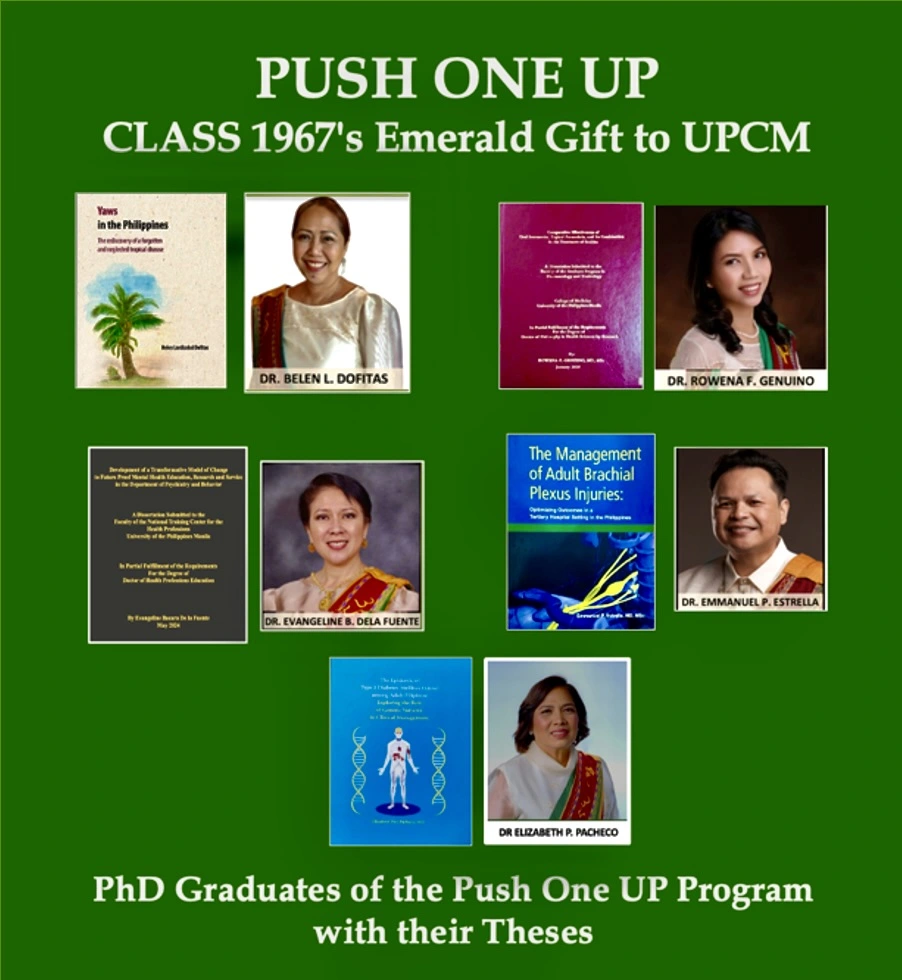
With the ACTA’s impressive results, the class was all ears for more of Dean Chiong’s projects. She had also earlier proposed to UPMASA that UPCM faculty aspiring for PhDs be financially assisted. When this request was rebuffed, Class 1967 picked it up and established the “Push One UP” program with a donation of $172,000. The name was a play on the UP fight song, “Push On UP.” The program gives $4,000 in tranches to each faculty candidate proposed by the Postgraduate Institute of Medicine under the leadership of Dr. Teresa Luisa Cruz, and has so far graduated five PhDs. Some of them have become authorities on Philippine diseases such as Yaws (Dr. Belen Dofitas) and Scabies (Dr. Rowena Genuino). Another alumnus of the program, Dr. Emmanuel Estrella, an orthopedic surgeon, recently made news when, as part of Dean Chiong’s SIBOL program (a project to stimulate surgical-biotechnological initiatives), he collaborated with UP’s Engineering faculty to develop a locally made, inexpensive modular external fixator for tibial diaphyseal fractures. The latter is normally a devastating injury for the working Filipino poor because they cannot afford the imported modular external fixators that run into thousands of dollars. The problem is now seemingly remediated. After a few years, Push One UP has helped increase the number of PhDs in the UPCM Faculty from 4% at the start of Dean Chiong’s deanship to the current 8%.
UPCM and PGH are recognized nationally and regionally in Southeast Asia as having excellent surgical programs. Dean Chiong wanted to expand the university’s ability to teach not only students and postgraduate residents but also established physicians from the Philippines and abroad. She conceived the Advanced Surgical Simulation Stations and asked for donations; Class 1967 members gave her two. Joseph Soliman and Ella Sutton-Soliman donated $140,000 to fund the Skull Base-Neurosurgical Station. Ponciano Salud donated $75,000 for the Laparoscopic Station, and 33 other classmates contributed $14,500 for an accompanying Hysteroscopic Station, which was named after classmate Dr. Emelina Canlas-Salud. These have all since been successfully used in several medical student and postgraduate courses.
Finally, Dr. Chiong requested that a second alumni endowment fund be established for UPCM, and the class again heeded her call. This fund was established in 2025 and is invested through UPMASA by Charles Schwab. Including yet unfulfilled pledges, it has raised $215,000. It will give 5 percent of its corpus annually to UPCM, which in 2025 amounted to $5,000 and, in 2026, $7,000. Active collections will be ongoing until 2027, at which time we will ceremonially present the project to Dean Chiong in Manila as our Diamond Jubilee gift. As a lasting tribute to the Dean who inspired us to give, and borrowing the title of a famous book, we have named the Endowment Fund “Charlotte’s Web.”
Looking Back with Pride
So here we are in late 2026. Almost all of us have retired from medical practice. We have watched with pride and delight the re-emergence of UPCM as one of the outstanding medical schools in Asia and the world. US News and World Report ranks UPCM as #212 in Clinical Medicine in the world. We are happy to note that we were not passive observers in this re-emergence.

We were blessed to have UPCM’s Dean Chiong as an inspiration late in our lives, which allowed and encouraged us to keep giving back to our alma mater. We have been previously honored and recognized by UPCM for our contributions. We are elated that, although this was not part of our motivation, our parent alma mater, the University of the Philippines, has also noticed us and seen fit to award us its Gawad Pangulo para sa Natatanging Alumni Award. It is true that the joy is in giving, but being human, we will gladly take the adulation too!
This article is dedicated to former UPCM Dean Dr. Florentino Herrera, Jr., who cared to listen to a bunch of new graduates disillusioned by the dishonesty of the Philippine Licensure Board Examinations in 1967, and to current UPCM Dean Dr. Charlotte M. Chiong, who inspired us to give back to UPCM and PGH with her profoundly insightful projects and academic vision, and the results that they produced.