UP in KOMIKS
By Susan Claire Agbayani
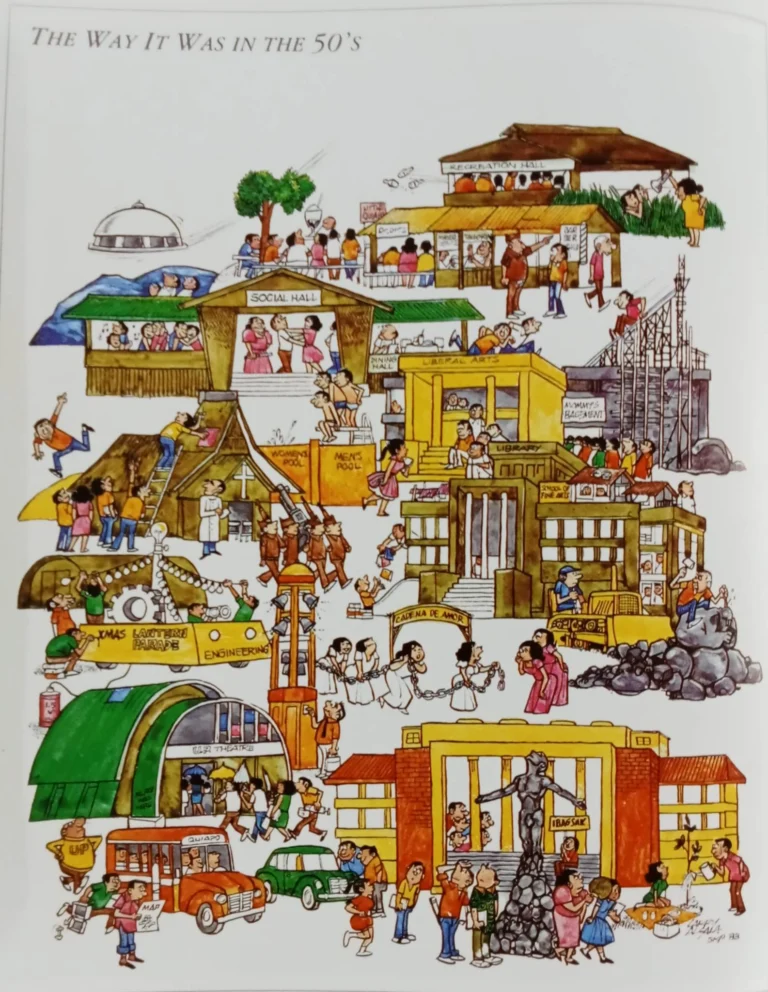
Perhaps, at one point or another, you have dined at Rodic’s—the iconic restaurant on campus (“since 1949”)—while craving tapsilog. And you must have noticed the reproduction of the work by cartoonist and former College of Fine Arts (CFA) professor, Larry Alcala, mounted on the wall.
The said reproduction is reminiscent of “Slice of Life,” which won the Best in Humor award at the 1988 Catholic Mass Media Awards. It originally appeared as half-page comic spreads in the Daily Express and, eventually, The Philippine Star several decades ago.
“Slice of Life” was a collection of caricatures portraying familiar neighborhood characters and depicting typical situations in everyday Filipino life, accompanied by incisive visual commentaries.
Who is the man behind the original drawings or sketches depicting life in UP during the 1950s?
Born in Daraga, Albay on August 18, 1926, cartoonist Lauro Zarata Alcala attended the UP CFA as a scholar of Don Ramon Roces of Manila Times. He graduated in 1950. Among his classmates were Malang Santos and the Spanish painter Juvenal Sanso.
Alcala is recognized as the dean of Philippine cartoonists. He was a founding member of the Samahang Kartunista ng Pilipinas, a local group of cartoonists.
His career as a cartoonist actually began in 1946 when he was just a college freshman at the Padre Faura campus. His comic strip “Islaw Palitaw” appeared in Liwayway.
He was also part of a group of artists, including Hugo Yonzon, who worked with Roces’s and Antonio Velasquez’s Ace Publications. This publishing company was established in 1947 and released various comic book titles such as Pilipino Komiks, Tagalog Klasiks, Hiwaga Komiks, Espesyal Komiks, and Kenkoy Komiks.
In the 1960s, while Danny Dalena was creating powerful caricatures for the Philippines Free Press, and Corky Trinidad was drawing caricatures of world leaders, Alcala was busy producing popular comic strips such as “Kalabog En Bosyo,” “Gorio,” and “Asyong Aksaya.”
In the 1970s and then the 80s,Nonoy Marcelo, Jose Tence Ruiz, and Jess Abrera (UPD ’64) emerged as cartoonists who lampooned social issues in the Philippine Daily Inquirer.
While cartoons were the lifeblood and a dependable source of income for Alcala, he also taught at UP Diliman for three decades.
A year after graduating from college (this time, in Diliman), he started teaching at his alma mater until his retirement in 1981. In 1978, he was named UP’s “Cartoonist-in-Residence” in recognition of his contributions in the field of cartooning, a year after the UP Alumni Association honored him with a professorial award in Fine Arts.
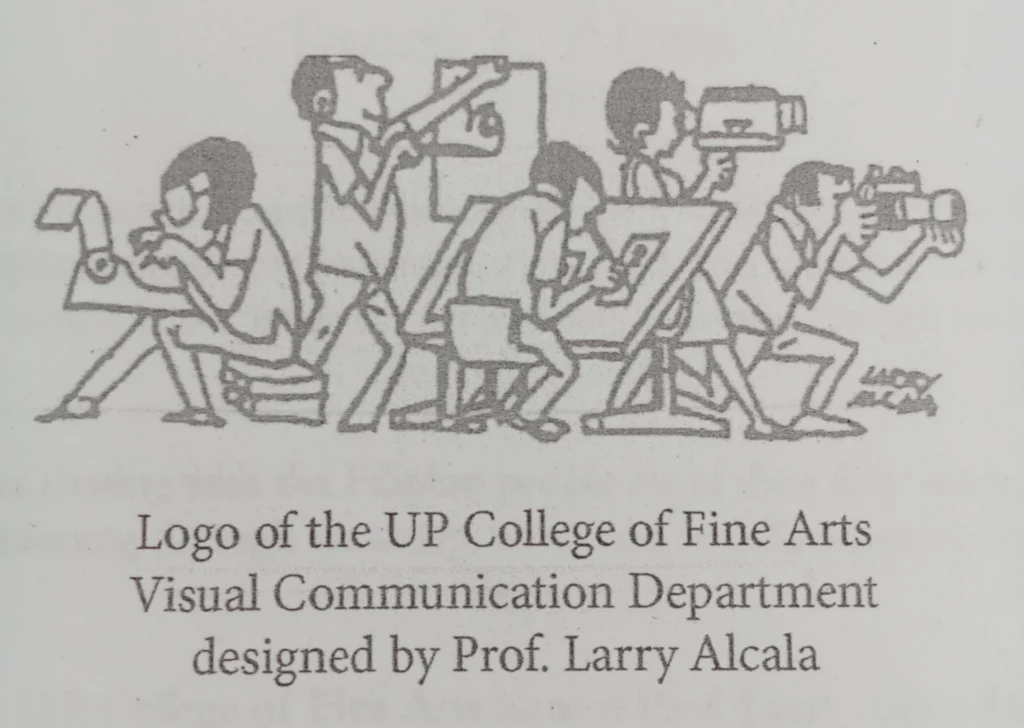
In April 2003, the UP CFA posthumously conferred upon Alcala the Gawad Alab ng Sining for “initiating the establishment of the Visual Communication Department where he taught, mentored, and inspired budding artists in the fields of Advertising, Editorial Design and Illustration.”
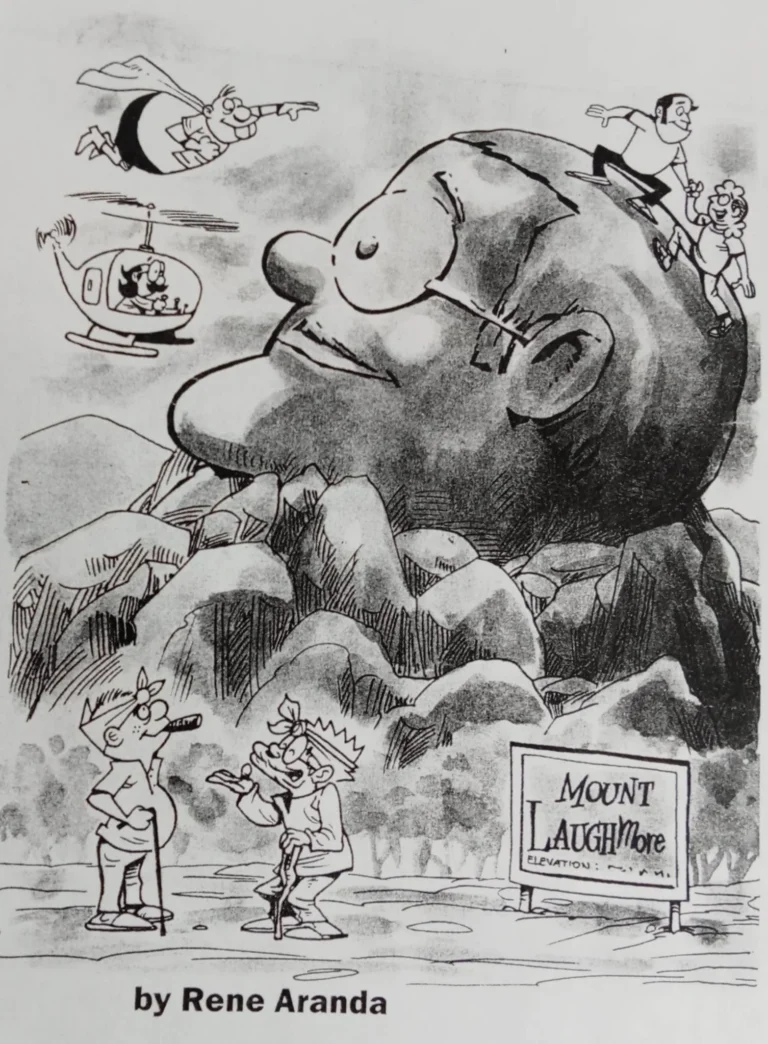
Among the people who acknowledge him as their inspiration are cartoonists Roxlee, Rene Aranda, and DengCoy Miel.
In his letter to the National Artist Secretariat of the National Commission for the Culture and the Arts, former CFA Dean Neil Doloricon said, “Larry Alcala, one of the pillars of Philippine contemporary cartooning, has entertained people from all walks of life for decades. He livened up the Filipino cultural traditions and the day-to-day living in rural as well as in urban centers.”
His leadership in spearheading the Vis Comm Department was also mentioned as a key factor in helping the college “keep abreast with international standards [in] graphic design programs in many advanced countries.”
He started animation classes using Super 8 cameras. He also pioneered animated cartoons for TV advertisements.
Cartoonist Boy Togonon, in his reminiscences of Alcala, said that during his lifetime, Alcala “created 500 characters, 20 comic strips, 6 movies, 2 murals, and 15,000 published papers” in over 50 years of cartooning.
In 2018, Alcala was posthumously conferred the title of National Artist for Visual Arts.
The Iconic TIBO Comic Strip of Kule, 1979-1982
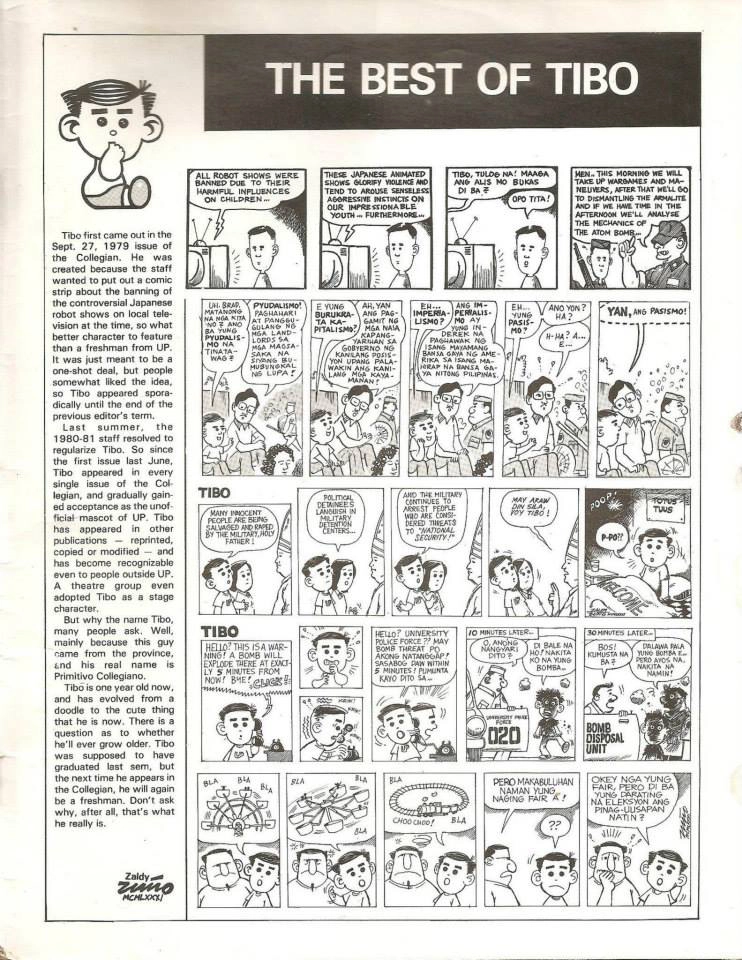
Sometime between 1979 and 1982, the Philippine Collegian featured a regular comic strip called “Tibo.”
According to “The Best of Tibo,” which appeared on the inside back cover of the Philippine Collegian Folio in 1981, Tibo first appeared as a cartoon character in the September 27, 1979 issue of Kule.
In the 1981 folio, however, Tibo appears in the upper left hand of the page as a “homage to Hello Kitty by Sanrio, which was popular at that time.”
“Si Tibo was initially conceptualized by the Collegian staff during Malou Mangahas’ time [as editor-in-chief] to react to the banning of Voltes V [by then Philippine president Ferdinand Marcos Sr.] during martial law,” said Zaldy Zuño, a staff artist from Kule who was then enrolled at the College of Fine Arts at that time.
“Kesyo violent daw [ang Voltes V] for the kids, so we made a comic strip with Tibo the probinsyano freshman making a commentary while watching TV. Over time, it appeared regularly as a strip sa Collegian and his initial design has evolved into the cute character that he is now. The only hitch is that Tibo is always a freshman,” Zuño shared.
Zuño succeeded future CFA dean Doloricon as the Kule staff artist. He continued to create the iconic Tibo comic strips throughout the terms of Roan Libarios and Bobby Coloma as EICs until 1982. Zuño recently retired from the animation industry.
KOMIKET
The Filipino Komiks Art Market, more commonly referred to as Komiket, was established as the “first komiks art market” at Centris Elements in Quezon City on Easter Sunday in 2015. That same year, it also held its inaugural Comic Book Creator’s Workshop, aimed at discovering new creators, according to Komiket president and co-founder Paolo Herras.
Herras graduated with a bachelor’s degree in Comparative Literature, with a major in Philippine Literature, from UP Diliman in 2003. He then pursued graduate studies in Philippine Studies, with a major in Film, also at Diliman.
Komiket had its first Komiket Awards in 2016 and began publishing komiks anthologies in 2017. In November 2019, Secret HQ was opened, serving as “our indie comic bookstore/office and providing a home for over 200 titles,” said Herras.
During the pandemic, however, “We pivoted online and gained access to over 6,000 readers for more than 300 Filipino komiks titles,” Herras added.
“We also started publishing more comic books and graphic novels (like Kevin Eric Raymundo’s Tarantadong Kalbo) and the Official Selection of the Philippine International Comics Festival (PICOF) [which] go through a Creator’s Lab, where we develop their original stories and characters into a full-length graphic novels,” he added.
In 2021, despite the pandemic, “Our comic books represented the Philippines at the Frankfurt Book Fair. It was the first time for Filipino komiks to have such a significant presence, with a dedicated shelf. And in 2022, half of the books in the Philippine stand at the London Book Fair were comics,” Herras explained.
In 2022, Komiket won its first National Book Award for Best Comics and Graphic Novel for Raymundo’s debut book.
“We also won five National Children’s Book Awards for Alandal, Little Wolf, Doobiedoo Asks, Twinkle Twinkle, and Alitaptap ng Pulang Buhangin,” he added.
Tori Tadiar won the Best Comics and Graphic Novel award at the Filipino Reader’s Choice Awards. Raymundo won the Good Design Award in the Philippines and Japan for his artwork, Tumindig.
Early this year, Komiket represented the Philippines at the Angouleme International Comics Festival in France, where five comic book anthologies were nominated for the Best Alternative Comics Award.
“We won two more National Book Awards this year,” Herras said, Alandal won the award for Best Graphic Novel in English, and Ang Mga Alitaptap ng Pulang Buhangin also received an award. “We have organized 34 komiks art markets in 9 cities nationwide, taught 8 comic book creator’s workshops, and published 34 comic books and graphic novels,” he added.
“We collaborated with the National Book Development Board to showcase komiks at the Philippine Book Festival, to make sure komiks has a dedicated space and better representation.” After successfully organizing PICOF online and connecting its community with international comics festivals, creators, scholars, publishers, and readers, Komiket is organizing the in-person PICOF in July 2024.
Check out Komiket at its website komiket.org.
J. Philip Ignacio’s Alandal
“I self-published my first book, The Merchant of Oltrarno, in 2018,” said J. Philip Ignacio, a graduate of UP Manila with a BA in Development Studies degree in 1995.
“It’s not a comic book, but rather a short story with 12 illustrations. Thanks to the paintings of Alex Niño and the calligraphy of Leigh Reyes, the book attracted much attention within the komiks community. The story was also well received, and I received positive reviews as a writer,” Ignacio clarified.
“When this was followed up with my first graphic novel (and Niño’s last), Alandal, it created a buzz in certain circles in the United Kingdom and the European Union. There will be a German edition of this book soon. It also won the 2023 National Book Award for Best Graphic Novel in English, which is a tremendous honor for a first-time komiks writer,” Ignacio said.
Others
There are others who have either achieved great success or are emerging as comic artists, not just in the Philippines, but globally as well. Some notable names include National Artist Francisco Coching, Ludwig Ilio, the father-and-son duo of Jess Abrera (A. Lipin) and Manix Abrera (Kikomachine), JP Cuison, Mervin Malonzo, Mong Barcelon, Adam David, Ethan Chua and Scott Lee Chua, Tori Tadiar, Tepai Pascual, Leinil Francis Yu, AJ Bernardo, Aaron Felizmenio, Armand Roy Canlas, Spider Dan, Elmer Damaso, Melvin Calingo, and many others.

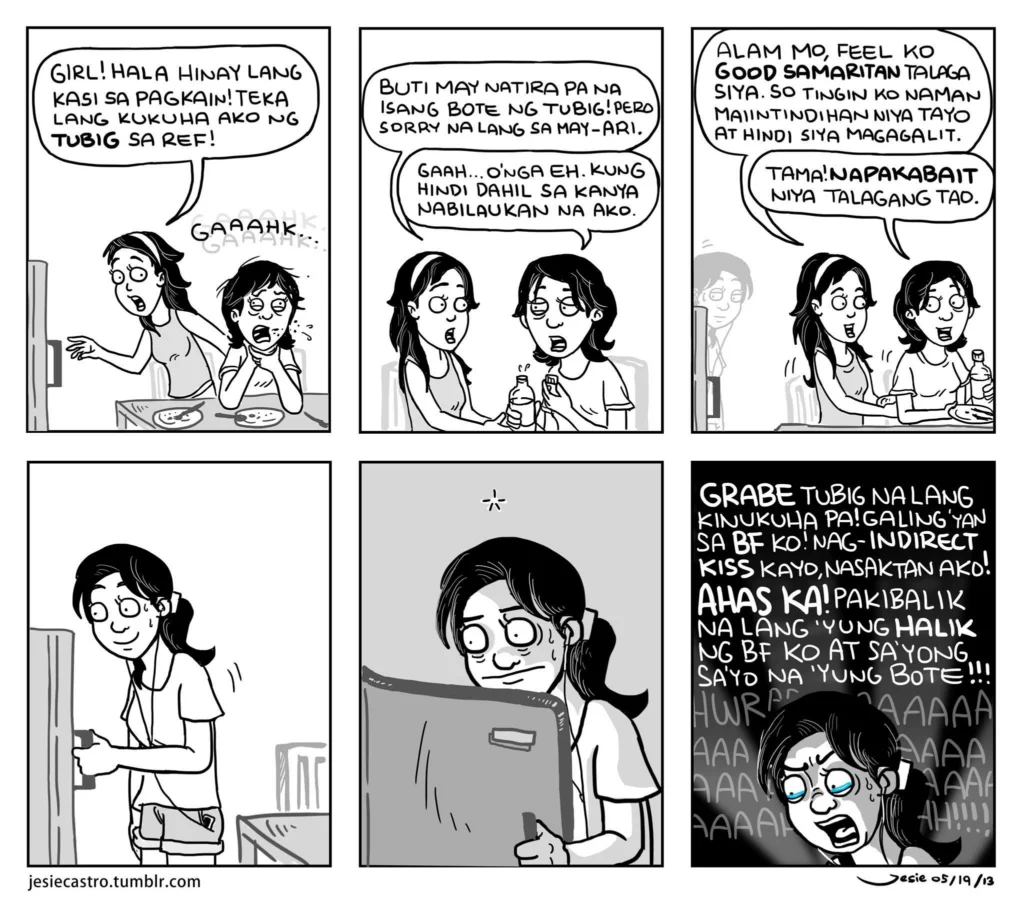
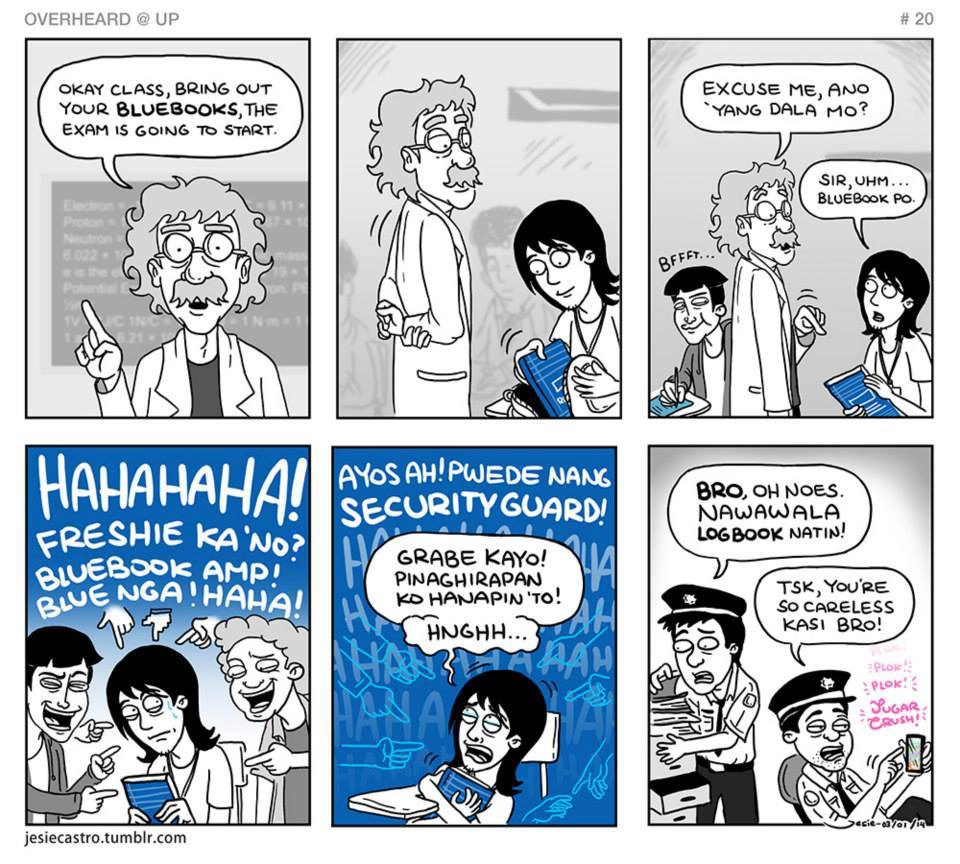
Jesie Castro of UP Baguio, did the Overheard at UP Illustrated series