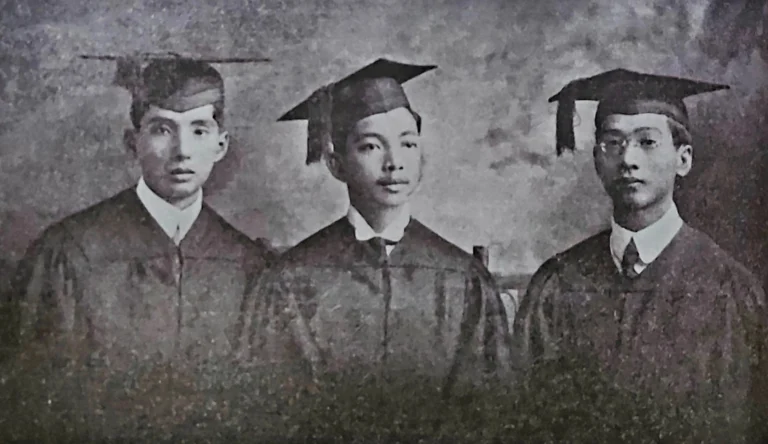
The University of the Philippines held its first commencement exercises on March 31, 1911, possibly in much simpler rites than today’s virtual graduations, a consequence of the pandemic. There were only ten graduates then, three from the College of Medicine, four from the College of Liberal Arts, and three from UP Los Baños. Cayetano S. Arellano, the country’s first Chief Justice of the Supreme Court, was conferred the University’s first honorary degree.
For its second batch of graduates, the ceremony was held in the historic Marble Hall of the Ayuntamiento de Manila (now Bureau of the Treasury). There were 30 graduates this time, including the country’s first woman physician, Dr. Maria Paz Mendoza-Guazon.
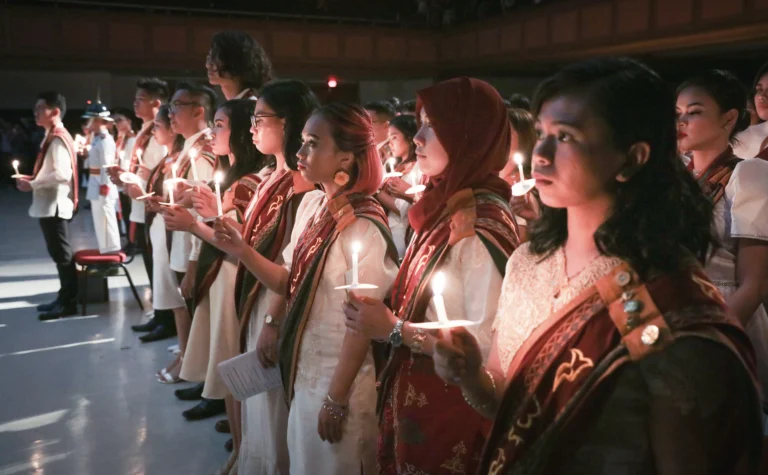
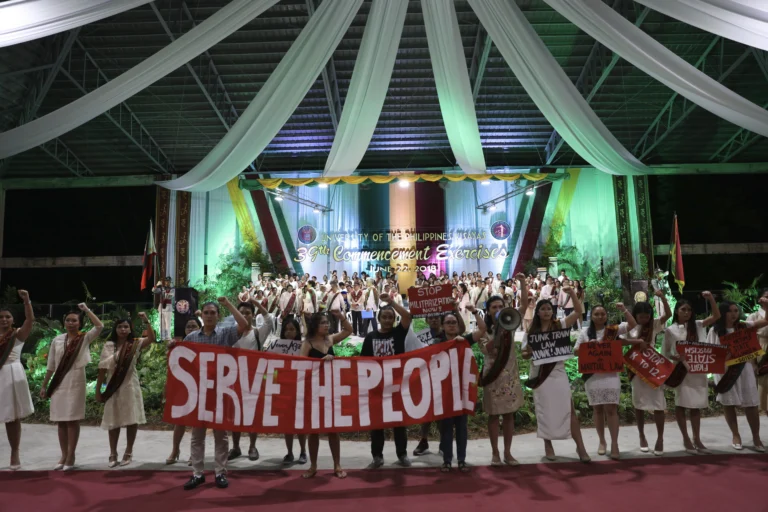
It’s been more than 100 years since those firsts, and as the University expanded, so have the traditions. Graduation is ultimately every student’s goal, and is commemorated with meaningful acts and traditional events.
There’s the photo with family and friends by the Oblation, of course, with the graduate wearing their hard-earned UP sablay. The sablay was adopted as the official academic costume in 2000. For those early graduates, such as the Class of 1916, it was the cap and toga over the formal baro at saya for women, while the men had on their best Americana (coat and tie).
For UP Manila and UP Diliman, the week leading to graduation meant dressing up for the Cadena de Amor. The tradition started in 1934, a festival “with the stately columns of the old Padre Faura halls for background.” The graduating ladies in white dresses would hold a long chain of flowers on one end. They would eventually meet up with the juniors attired in pink dresses, who were holding the chain on the other end.
The chain symbolized the “continuous flow of ideas and ideals of UP through the students, all designed for the service of country, mankind and God.” The festival moved to the Sunken Garden in Diliman in 1949 when most of the university moved to the Quezon City campus. A program and ball were also held as part of the event.
The flower chain festival was last held in 1968, and was not revived due to a lack of funds and the changing social climate.
By the 2000s, a different flower began to bloom and signal graduation in Diliman. Sunflowers planted throughout the University Avenue meant that graduation was coming, along with a hopeful, sun-kissed future ahead. Even when the academic calendar shifted to the start of the rainy season in 2014, Diliman continued with this gift for graduates. A more resilient variety of sunflowers was obtained and planted. Sunflowers were again in bloom last year, lending brightness to a season darkened by the health crisis.