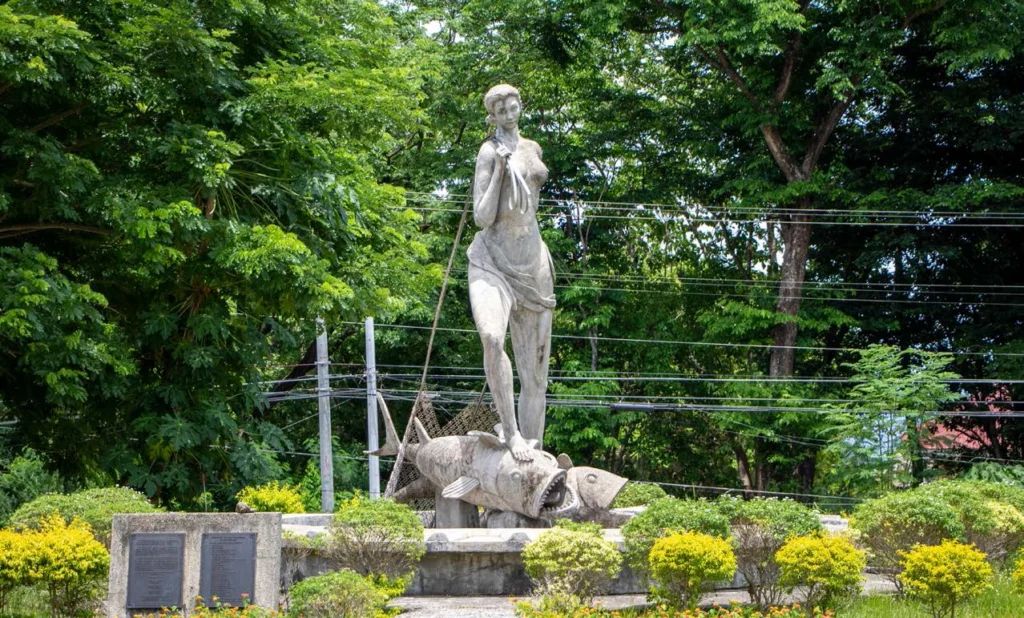
The diwata, a nature spirit, is one fascinating being in Philippine folklore. It is believed that the diwata ng dagat, or sea fairy, is keeper of the oceans, provider of a bountiful catch, protector of the coast, and the patron of the fisherfolk.
In 1988, when College of Fisheries, UPV’s flagship college, was transferred from the urban Iloilo City campus to the seaside Miagao campus, UPV sought a symbol to represent its leadership in the field of fisheries through a sculptural landmark. In 1998, the UP System approved a P300,000 initial funding for the project.
The University of the Philippines Visayas (UPV) chose the Diwata ng Dagat to represent its strength in fisheries and marine sciences because she is an icon that projects beauty, strength, wisdom, compassion, and power. National Artist for sculpture Napoleon V. Abueva was chosen to craft the statue in 2001. By July of 2001, the Diwata ng Dagat statue was completed and unveiled.
Standing 16 feet high, this gigantic concrete statue of a water goddess seems to have risen from water, towing a metal net, and stepping on three giant fishes. As with Tolentino’s Oblation, Abueva’s Diwata ng Dagat stands naked, except for a small covering of its groin area.
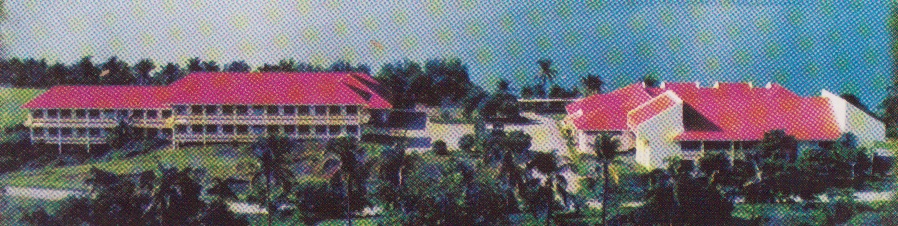
The statue is Abueva’s first work with a sea motif. It stands on a small roadside hill and faces the present College of Fisheries and Ocean Sciences (CFOS) Administration Building. Behind it is the sky and the sea, giving it a majestic background.
For UPV, the Diwata ng Dagat symbolizes not just the ideals of CFOS to remain the national center of excellence in the field of fisheries, aquaculture, and marine science education, but also its hopes for the country’s better future through fisheries sciences.
CFOS is now the country’s front-runner in fisheries and marine science education. The Commission on Higher Education (CHED) named it the Center of Excellence in Fisheries Education in 1998. Its Institute of Marine Fisheries and Oceanology was also named the Center of Development in Marine Science in 1998 and in 2006.
Much like UPV’s yearning to have a symbol of excellence for its flagship program in the 90s, back in 1945, Iloilo City also sought to have quality education available to its students whose education was just interrupted by World War II.
Recovering from devastation, Ilonggos believed that top-quality education would lead them back to progress. The city officials dreamed of having the premiere university start this new era of education in the region.
On December 18, 1945, the Municipal Board of Iloilo City, led by then mayor Fernando Lopez, passed a resolution to authorize the opening of a campus of UP in Iloilo City. The Iloilo City Hall was to become the site of this new branch.
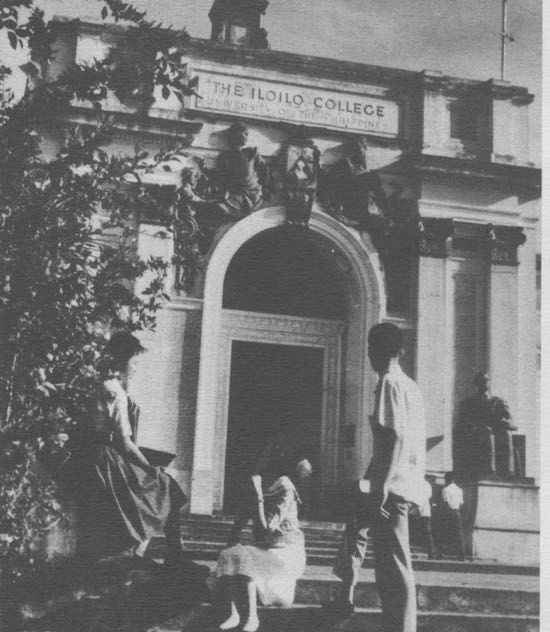
On July 1, 1947, exactly 75 years ago, the Iloilo College, University of the Philippines formally opened. UP’s brand of education finally became present in Iloilo.