
Alumna Tribute
Remembering Dr. Marivic Carpio-Bernido,
a champion of science and education
By Danielle Uy
Dr. Maria Victoria Carpio-Bernido was a teacher, not just by profession but also by vocation. Her life was a testament to the power of education.
She constantly challenged limits—both hers and that of her students. She held on to her faith, always believing that things would turn out for the best. And a great physicist that she was, she observed situations to understand its pain points and worked her hardest to pursue solutions.
An alumna of the BS Physics program of the University of the Philippines (UP) Diliman, Bernido, fondly called “Marivic” by those who personally knew her, was described by her peers as a quiet and shy student.
Dr. Ronald Banzon of the National Institute of Physics (NIP) recalled meeting her through the UP Physics Association, describing her as “specially reserved for the most part.” But Banzon also noted that during her formative years as a teacher, Bernido “grew fairly well.”
In 1983, Bernido started working as an instructor at the NIP. “She was my teacher in electromagnetism,” fondly recalls Dr. Maricor Soriano, now a professor at the NIP. “My classmates and I were blown away by how she taught with passion.”
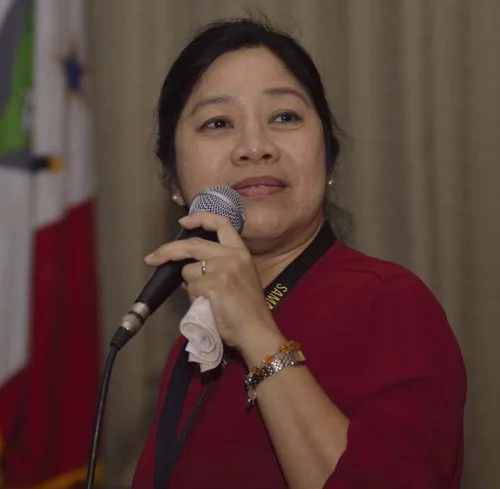
Dr. Cristine Villagonzalo of the NIP, who was Soriano’s classmate in that class, could attest to this: “Electromagnetic Theory is the most feared subject in the third year, as usually many students fail in this course. But when she taught this course, she did it so systematically and clearly that we came to love it.”
Bernido exceeded expectations as a teacher. Not only did she teach theory and application, but she was also a great storyteller, inspiring her students with the lives and contributions of scientists.
“Her approach to teaching a course was holistic. She taught not just the physics and the equations, but also included the history and how the scientists were able to derive them,” Villagonzallo said.
Since Bernido had traveled to do research globally, she would tell her students stories of foreign countries—how they’d honor scientists by naming streets after them. Bernido had aspired for the Philippines to follow suit, said Soriano. But while she didn’t see this in her lifetime, she had already, unarguably, impacted the world of science through her teaching.
With her influence, Bernido inspired several students to become scientists. “Many of us stayed in the academe as teachers and researchers because of her example. Most importantly, we have become mentors to the next generation of scientists,” Villagonzalo shared.
Pursuing a higher calling in a lowly town
From the beginning of her academic career, Bernido was consistent about what she valued most in life — her students. She pursued MS in Physics and Ph.D. in Theoretical Physics at the State University of New York, equipping herself with deep knowledge in her field before returning to UP to teach.
“She and her husband (Dr. Christopher Bernido) decided to come back because they felt it was their mission to elevate science in the country. They could have stayed abroad and flourished there, but their motivation was to come back. That was very inspiring,” Soriano said.
In 1999, Bernido, along with her husband, resigned from UP to manage a small, rural high school in Jagna, Bohol. Marivic took over as the principal, and Christopher as the president, of the Central Visayan Institute Foundation (CVIF). Upon moving, the couple was immediately presented with a crisis; the school lacked resources.
As scientists, the Bernidos investigated the problem: How could they deliver the best instruction to our students? So, they pioneered an independent learning teaching method, the CVIF Dynamic Learning Program (DLP).
With a low budget, limited equipment, no internet access, and no textbooks, Marivic created modules, which facilitators would copy onto the chalkboards, and students would copy onto their notebooks. Through this method, students got to practice their penmanship, grammar, and sentence formation, all while internalizing the important lessons.
Proving that the method was effective, many of Marivic’s students would later pass the UP College Admissions Test (UPCAT), and the number of passers increased through the years. In 2010, she and Christopher both received the Ramon Magsaysay Award for this progressive pedagogy. A decade later, the Department of Education (DepEd) would adopt the CVIF-DLP method to encourage students to learn independently amid the pandemic.
An influence beyond the classroom
Indeed, one would perceive Bernido as a powerhouse in the field of education. But to her students, that isn’t even the most remarkable thing about her. To them, it was that she lived with an open hand.
“Whenever we needed her help and advice, or even a resource speaker in her line of expertise, we could always count on her. She never said no when invited despite her busy schedule. She always had time for us,” Villagonzalo recounted.
While writing her master’s thesis, Villagonzalo even stayed in the Bernidos’ home in Bohol so that she could focus. “We were welcome to visit their home. We had seminars and research discussions,” she added.
Soriano also recounted the times Bernido would personally seek financial assistance for her students in CVIF. There were times when, even though her students would pass the UPCAT, their parents would not allow them to pursue college due to financial restraints.
“Her students would cry to her, she’d tell me. So there were times that she would personally look for scholarships.,” Soriano said. “She always mentioned, ‘Hindi man kami nagkaanak, andami rami naman naming anak.’ (We didn’t get to have children, but I still consider myself having so many children),” Soriano added.
A scientist’s immense faith
Bernido put only one thing above her family and students: God. “She reminded us to pray and go to church. This is not typical behavior for a scientist, but she was never ashamed,” Villagonzalo revealed.
Soriano said Bernido dared to nurture her students, despite all odds, because of her massive faith. “She found solace in (her faith),” Soriano said. “In fact, before she died of cancer, she took it like a champ. She said, ‘This suffering will lead to some goodness. I will endure this suffering.’”
Inevitably, Bernido passed on her optimism to her students.
“While I was growing up, adults usually told me to choose a career that will make you rich or make your life comfortable. But for Ma’am Marivic, you choose a career that you value and find meaning in,” Villagonzalo shared.
An impressive educator, a remarkable scientist, and a beloved wife and friend, Bernido passed away on January 6, 2022. Until the end, she inspired so many people around her, and her impact will forever live on.