
Social Science Feature
UP Alumni Doctors & Social Scientists Address Vaccine Hesitancy
By Susan Claire Agbayani
Priority Groups
In the Philippines, the National Immunization Technical A dvisory Group ( NITAG) for the Covid-19 Vaccine has prioritized vaccination according to groups. Category A includes workers in frontline health services, all senior citizens, persons with co-morbidities, frontline personnel in essential sectors (including uniformed personnel), and the indigent population.
Under Category B are teachers, social workers, other government workers, other essential workers, overseas Filipino workers, and other remaining workforce. Also included in this category are “socio-demographic groups at significantly higher risk other than senior citizens and poor population based on the NHTSPR.” The rest of the Filipino population “not otherwise included in the other groups (already mentioned)” fall under Category C.

DR. PERNIA:
“If we go by the statistics that news gives us, we’re pretty good,” having covered 61% of the population, noted Dr. Elena Pernia, UP System’s Vice President for Public Affairs. As of press time on 26 April 2022, the vaccination counter revealed over 145,739,000 vaccinations. And by 20 June 2022, the vaccination counter of DOH had already indicated 152,460,366 total doses administered.
High Covid-19 Vaccination rate among UP Personnel
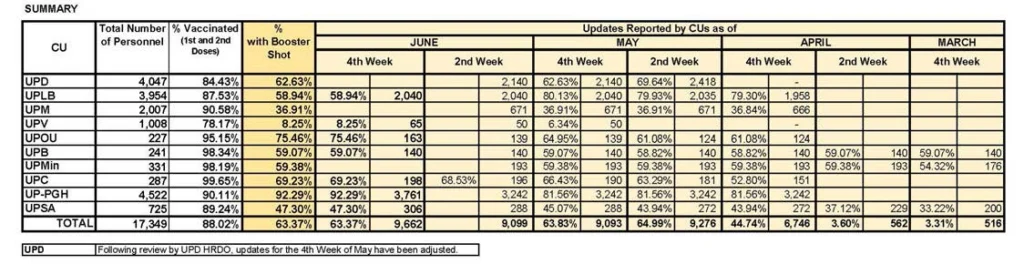
There is a high Covid-19 vaccination rate among personnel of the University of the Philippines – system-wide – which is at 88.02%, with two doses each, as of June 2022.
According to the Headcount of Vaccinated Personnel per Office/Unit Report, as of the fourth week of June 2022, the highest vaccination rate among the constituent units is UP Cebu, at 99.65%.
In the Diliman campus, 84.43% of faculty and staff are vaccinated. The vaccination rates of the Los Baños and Visayas campuses are at 87.53% and 78.17%, respectively.
A total of 9,662 (or 63.37%) – system-wide, have been boosted — with the highest booster doses administered at UP-Philippine General Hospital (PGH) at 92.29% or 3,761 employees. Constituent units include campuses in Baguio, Diliman, Los Banos, Open University, Manila, Visayas, Cebu, and Mindanao.
Ninety-five percent (95%) of UP students across different campuses have received their vaccines. They have completed the required minimum doses (1 shot for Jansen, and two shots for other vaccines), said Dr. Richard Philip A. Gonzalo, UP Assistant Vice President for Academic Affairs (Student Affairs), and concurrent director of the UP Office of Student Development Services, via an e-mail to Carillon.
This is based on the UP Student Survey on the Gradual Opening of UP campuses — which was administered online and which gathered a total of 33,349 responses on Dec. 1-9, 2021. The findings were presented on Feb. 28, 2022, during the UP System-wide Faculty Summit on the Gradual Reopening of Campuses.
Dr. Gonzalo hastened to add that the student survey was organized “before booster shots were mandated for this cohort of the population.”
There is vaccine hesitancy, however. Those who hesitate to be vaccinated invoke either religion or certain diseases. Some deem themselves too old to be vaccinated. Boosting rates are low and “We have a surplus of the vaccines,” Dr. Pernia noted.
But then, “Covid is a public health concern. No one is protected unless EVERYONE is protected. Viruses mutate, allowing it to extend its life,” said Dr. Nina Castillo-Carandang, a professor of health sociology, clinical epidemiology, and global health at the UP College of Medicine’sDepartment of Clinical Epidemiology.
Mis- and Dis-information; Practice Good Information Hygiene
“What kind of pandemic are we in? We are not only in a pandemic. We are also suffering from an INFOdemic. We [receive] a lot of mis- and dis-information that has disenfranchised people from evidence-based health information. That is a key barrier. This has caused a lot of confusion, has led to mistrust and disinformation to flourish, has impede[d] vaccination efforts, and increased vaccine hesitancy,” added Dr. Castillo-Carandang.
Privileged Access
“We keep on saying that all vaccines are equal. But people don’t believe it. There have been reports of privileged access especially when supply was limited…‘missteps’ in procurement, budget, competition for vaccine supplies and lack of confidence in the government’s vaccination program,” Dr. Castillo-Carandang said.
“We’re using eight Covid-19 vaccines [with Philippine FDA EUA approvals]…we have so many because we were desperate to get access to any vaccine. The first ones which arrived [were] marked by great inequity where people had secret vaccinations. There was smuggling of the vaccines, too.” Dr. Castillo-Carandang said.
People trust scientists, doctors, health experts
“Solidarity, trust and equity are needed for the Covid-19 vaccination program. Vaccination will help us protect not just ourselves but also our families, colleagues and communities,” she declared. She said that experts from institutions like the UP College of Medicine are ready to lend their help, adding that based on her own experience, people are convinced to get vaccinated once doctors and other health experts explain how immunization works. She revealed additional survey results show that about 70% of respondents trust scientists, doctors and other health experts.
At a town hall meeting of the Department of Health (DOH) in mid-January 2021, Dr. Castillo-Carandang addressed issues on vaccine hesitancy and the crucial role that health workers and social scientists play in increasing vaccine confidence.
Stating that there are enough social scientists in the country, but who haven’t been invited as often as other experts, Dr. Castillo-Carandang explained that beyond physical health, there is social, mental and emotional well-being. Health social scientists (like her) offer behavioral and holistic insights beyond clinical medicine.
During a virtual forum of the Union of Local Authorities of the Philippines, she said that to counter lots of ongoing misinformation and under-information, she urged media to always hear it from the sources; find the experts and their views, tap into the speakers’ bureau of DOH, engage more in networking, simplify things; and to depend not only on social media but also on traditional sources.
Study on Dengvaxia Scare
In late 2018, Dr. Pernia and her team of researchers did a study on the Dengvaxia scare; on what led to vaccine hesitancy. They had pilot areas in Luzon (Pangasinan, Tarlac and Metro Manila), Visayas (Cebu and Bohol) and Mindanao (Davao de Oro). The quarantines due to Covid prevented the research team to travel during the prolonged lockdown. Since the quality of data they had already collected sufficed, they requested the Department of Science and Technology (DOST) to allow them to end data gathering.
During a presentation the team made to Secretary Fortunato De La Pena, Undersecretary Rowena Cristina Guevarra, and Philippine Council for Health Research and Development (DOSTPCHRD) Executive Director Dr. Jaime Montoya — the technical group – the research team was told that while dengue was an important issue, was it possible for them to “shift to Covid-19 instead” and do something on Covid communications?
Communicating Covid-19 in Post-Quarantine Philippines
The UP-led research project “Communicating Covid-19 in Post-Quarantine Philippines” aimed to understand the public’s knowledge, attitudes, and practices related to Covid-19. It was funded by the Department of Health (DOH) and DOST PCHRD, under the Advancing Health through Evidence-Assisted Decisions with Health Policy and Systems Research (AHEAD-HPSR).
It looked into information sources and how these sources affected public perception and understanding of the novel coronavirus, preventive measures, and acceptance of policies and programs in response to the health crisis. UP System Assistant Vice President for Public Affairs Maria Angelica D. Abad led focus group discussions (FGDs) for them to develop a concept.
Mga Istorya sa Likod ng Covid-19 PSAs
“We developed a series of Public Service Announcements (PSAs) with an overarching theme of stories behind Covid-19 or ‘Mga Istorya sa Likod ng Covid-19’ to address vaccine hesitancy,” said Pernia.
Lasting from anywhere from 34 to 80 seconds, the videos tackled situations involving frontliners, health workers, senior citizens, adult men, and even children. Some of the videos were in the form of animated short videos. The tagline was “Dahil Mahal Ko Kayo, Magpapabakuna Ako (Laban sa Covid-19).”(“Because I Love You, I Will Have Myself Vaccinated against Covid-19).” The videos were the products of empirical study; they were well-grounded on information. Their production was not much of a problem. The next step though was how to disseminate the videos to as wide a market as possible, to address vaccine hesitancy. They sought the DOH communications group and private sector partners who had them placed in all platforms possible.
Stop Covid Deaths webinar series
The team went back to the drawing board and conducted another round of FGDs after the PSAs were developed. What emerged from the FGDs was the need to come up with educational webinars that would feature authorities on Covid-19, and how the program’s listeners or viewers could live with it and the prolonged
lockdown. The aim was to change minds.
The university launched the “Stop Covid Deaths” webinar series, the country’s first and only frontline-focused medical webinar series. It was a trailblazer, and endeavored to discuss, disseminate, and adopt knowledge on treating and managing Covid-19 by tapping into the experiences of clinicians, hospital administrators, and researchers who are UP alumni.
It also sought “possible standards of care for Covid-19 patients and also seek to protect the entire health system from the devastation of viral spread through measures and interventions that will insulate the whole range of the practice of medicine and all its sub-specialties in the post-ECQ phase, and for continuing pandemic preparedness and response.” Lastly, it aimed to remember all heroic front liners “who have fallen during this pandemic; whose sacrifices have enabled the country to persevere during the darkest times.”
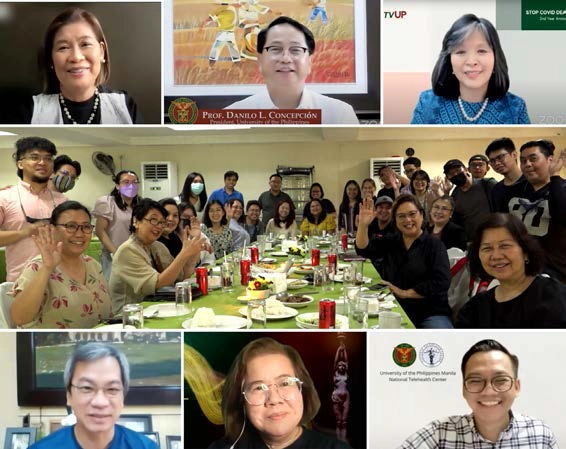
The university’s partners for the series are the UP National Institutes of Health-National Telehealth Center (UP NIH-NTC), UP Philippine General Hospital and TVUP, the internet television network of the University of the Philippines. It is It is hosted by Dr. Susan Pineda Mercado and Dr. Raymond Francis R. Sarmiento, both from the UP NIH-NTC. It marked its second year during its 96th episode on 22 April 2022.
International Award for the webinar series
The UP’s “Stop Covid Deaths” Webinars series was recently awarded by the US-based International Association of Business Communicators (IABC) a Gold Quill Award of Merit. Weekly live tweets and streams may be accessed via the Twitter account of the UP System; and the YouTube channel and Facebook page of TVUP.