Our deeply held tradition to uphold honor and excellence as members of the University of the Philippines (UP) community is kept alive by actively engaging in public service even after we close the chapter of our student life on campus. With the Philippines ranked 3rd among all countries in the 2016 World Risk Index of the United Nations University in terms of exposure to natural hazards, one domain where we find our alumni shaping the discourse in evidence informed policy and scientific discovery is the area of Disaster Science. The research in the field of disaster science range from climate change adaptation to pandemic response.
This article features individuals, groups, and institutions peopled by exemplary UP alumni in this field of practice.
First on our roster is the Director of the UP Resilience Institute (UPRI), Dr. Alfredo Mahar A. Lagmay, who leads cutting-edge projects on Resilient Campuses across all the UP constituent universities. He is also at the helm of the UP Nationwide Operational Assessment of Hazards (NOAH) – a research center for climate actions and DRRM. The UP NOAH team’s work spans flood modeling, planning, web-based geographic information systems, and hazard detection. The output of their research is freely-accessible and backed by the latest scientific understanding of DRRM.
The UPRI is an initiative of the UP System that aims to commit 5% of its combined regular full-time academic human resource to a pool of active scholars engaged in multihazard, multi-disciplinary, multi-sectoral, and comprehensive disaster risk reduction and management (DRRM) work. This is a considerable contribution to DRRM by both alumni and current members of the UP community. The Institute’s mandate covers undertaking research and creative work, knowledge sharing, education, and institute building.
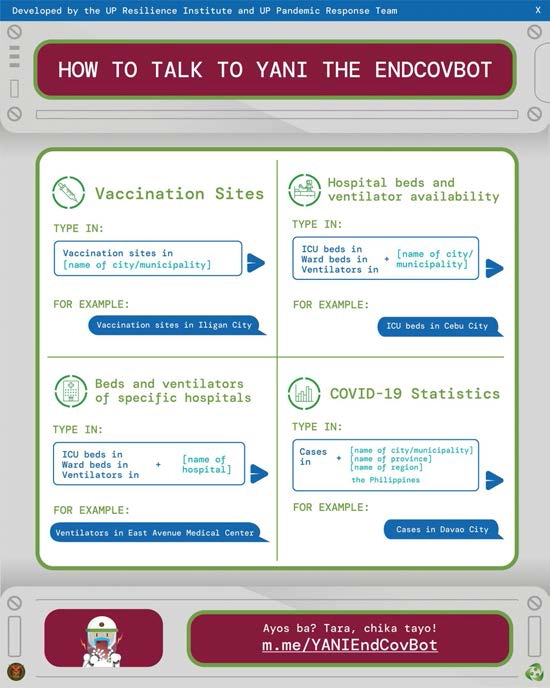
Working quietly behind the scenes is a group of alumni – Lance Lim, Obee Principio, and Gene Tan, who fondly recalled their experience as 3rd-year Computer Science students from the College of Engineering in 2020 when they developed Yani the Endcovbot. Yani is an artificial intelligence-enabled Messenger chatbot designed primarily to answer questions regarding the Corona Virus pandemic.
This covers queries ranging from pandemic statistics to vaccinatioxn sites, hospital beds, and ventilator availability – all critical information that individuals need to manage the virus in the event they get infected with it. Yani is also integrated into the endcov.ph site that is managed by the UP Resilience Institute (UPRI) team as part of the UP COVID Pandemic Response Team.
And let us not forget Professor of Mathematics Dr. Guido David, who applied his expertise in numerical analysis and mathematical modeling to Covid-19 scenario building. He and his childhood friend, Assistant Professor Ranjit S. Rye of the Department of Political Science, along with other colleagues, gained prominence at the height of the Covid-19 pandemic through OCTA Research, their private polling, research, and consulting firm.
They formed OCTA because they observed that there was a niche in an area of pandemic research that their expertise could fill at that time. The predictive models and pandemic projections their group produced became one of the main references that both the private sector and government bodies relied on to formulate plans and structure their own pandemic response.