
Beyond Connectivity: UPMASA’s Legacy of Service, Innovation, and Giving Back
By Dr. Cecile Pasion-Bregman, Dr. Ma. Guia Razon-Palma, Dr. Constancia Somera-Uy & Ness Liwanag
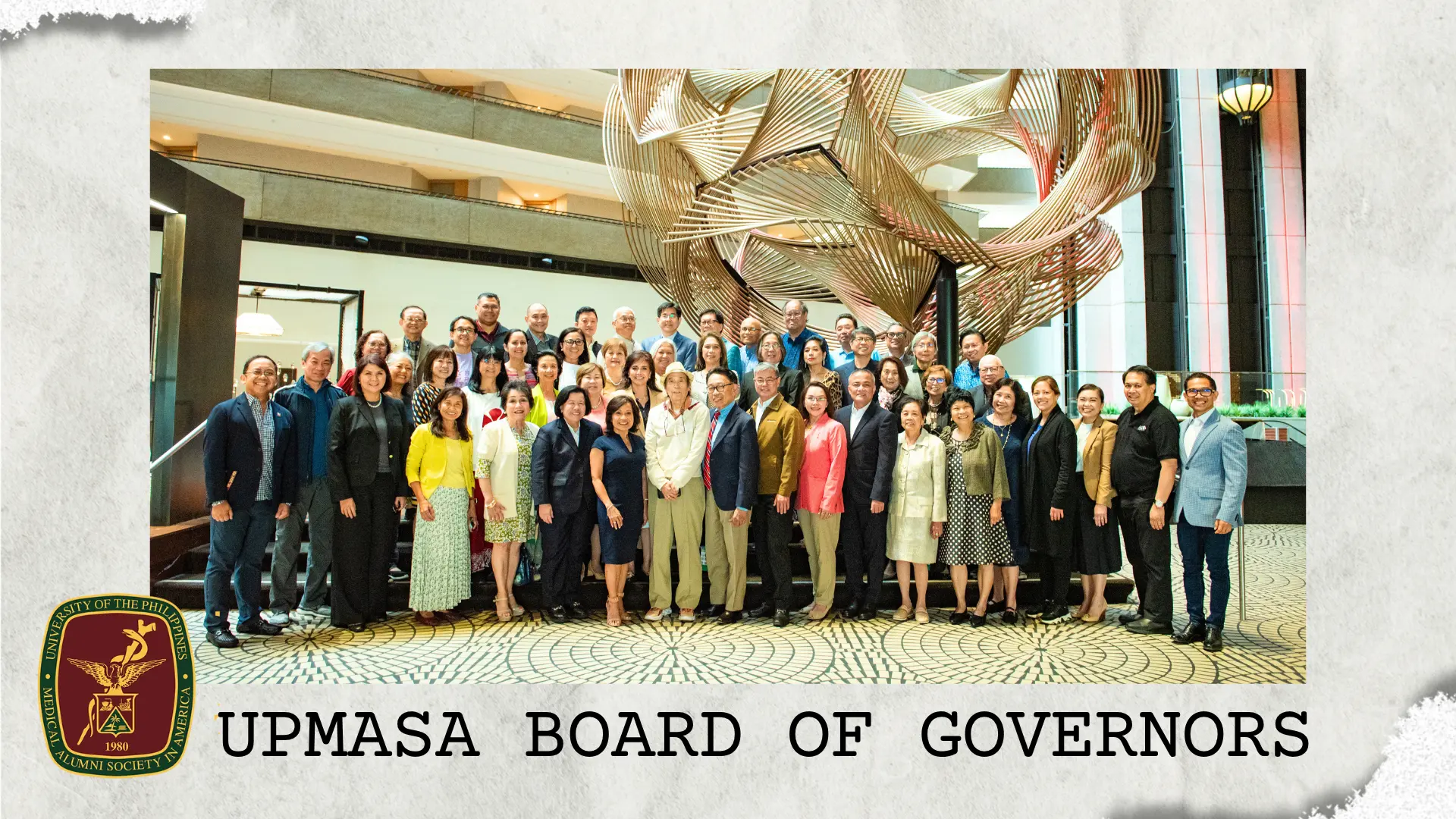
Distance has never diminished the connection between graduates of the University of the Philippines College of Medicine and their alma mater. For more than four decades, the University of the Philippines Medical Alumni Society in America (UPMASA) has transformed that connection into something greater: a community of physicians and health professionals united not only by shared memories, but by a continuing commitment to education, health care, research, innovation, and public service.
Today, technology allows alumni across continents to communicate and collaborate almost instantaneously. Yet UPMASA’s story demonstrates what lies beyond connectivity. Connection becomes meaningful when it leads to action—when alumni use their knowledge, resources, professional networks, and collective generosity to create opportunities, strengthen institutions, advance health care, and serve communities.
From a Small Gathering to a Global Community
UPMASA’s roots can be traced to 1960, when six or seven UP medical alumni and their spouses gathered at the Philippine Garden Restaurant in New York City. It was a modest social reunion, but it planted the seeds of an organization that would eventually connect generations of UP physicians throughout North America.
The idea of creating a formal alumni society gained momentum during the Alumni Nights of the Association of Philippine Practicing Physicians in America conventions in 1978 and 1979. On August 16, 1980, UPMASA was formally organized at the Omni International Hotel in Miami, Florida, with 44 alumni in attendance.
What began as a small circle of physicians seeking fellowship and a way to give back developed into a national network of more than 2,000 members in 17 chapters across North America.
Yet UPMASA’s greatest achievement is not simply the size of its membership. It is what that network has made possible.
Transforming Connection into Opportunity
Education has long been at the heart of UPMASA’s service to the University of the Philippines.
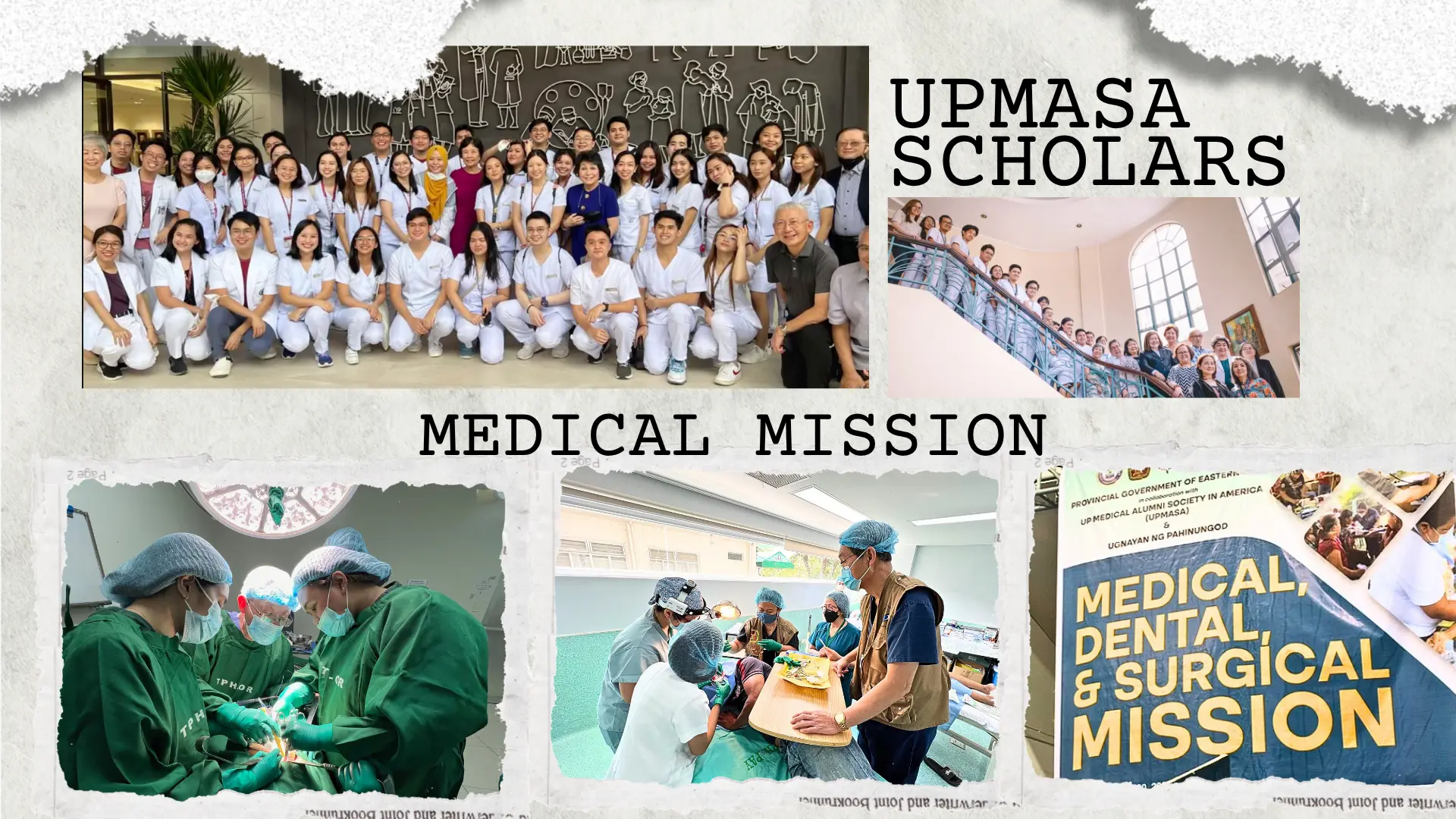
Since 1990, UPMASA has supported more than 1,500 scholars, while also funding professional chairs, educational initiatives, and grants. Its scholarship programs have extended beyond the UP College of Medicine to the UP College of Nursing, UP College of Public Health, UP Population Institute, UP Integrated High School, UP Virata School of Business, UP School of Health Sciences in Palo, Leyte, and, more recently, the UP Mindanao School of Medicine.
Through its regular and Legacy Scholarship programs, alumni thousands of miles away have directly influenced the lives of future physicians, nurses, midwives, public-health professionals, business leaders, and other UP students.
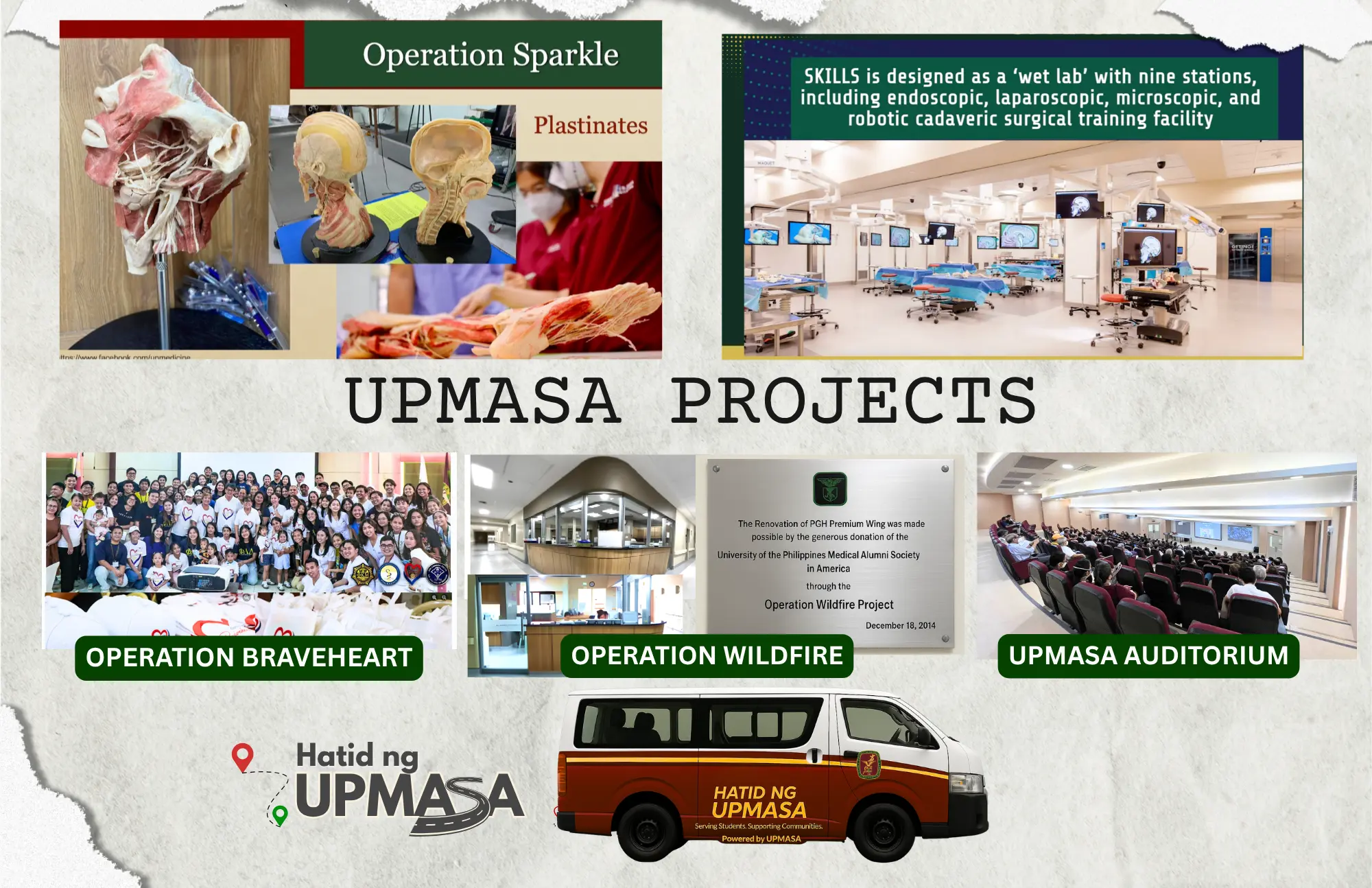
UPMASA has also responded to urgent and practical student needs. During the COVID-19 pandemic, it supported the Pantawid Program of UPCM Dean Charlotte Chiong, which provided medical student scholars with assistance for daily basic needs. It also supported fundraising efforts led by UP Manila Chancellor Michael Tee to provide meal allowances for students from low-income households and the Hatid ng UPMASA van program which helped address the student and faculty transportation needs. UPMASA helps ensure that talented students are not forced to abandon their education because of financial hardship.
Building Institutions and Advancing Innovation
UPMASA’s contributions extend beyond individual scholarships. The organization has also helped strengthen the institutions that educate future health professionals and deliver health care to the Filipino people.
Among its significant projects is the UPMASA Auditorium in the Henry Sy Medical Building, an important venue for lectures, conferences, academic programs, and professional gatherings supporting the educational mission of UP College of Medicine.
UPMASA has likewise supported medical education and research by funding Operation Sparkle, the UPCM Edutech Studio, the SKILLS advanced surgical wet laboratory and the expansion of the UP Manila library sustaining its legacy as a pioneer in digital library and internet connectivity.
Other initiatives support patient care, and institutional development through initiatives such as the Operation Wildfire which renovated the private patient rooms, the PGH-MFI Century Club and the Helping Women and Others Project and the renovation of the on-call rooms for interns and residents at PGH reflecting UPMASA’s continuing commitment to the Philippine General Hospital and to improving services for patients, families, trainees and health care workers.
Its support for HIV-related testing and diagnostic approaches reflects the importance of evidence-based health care and a willingness to address sensitive public-health concerns through early detection, treatment, prevention, and education.
The organization has also demonstrated its ability to respond to urgent needs through focused campaigns such as Operation Braveheart and Doctors to the Barrios Laptop Program. Though each initiative has its own purpose and context, they share a common principle: when a need arises, the alumni community can move from concern to organized action.
These efforts require more than financial contributions. They depend on coordination among alumni, UP leaders, health professionals, community partners, donors, and volunteers—and on the trust that collective action can produce meaningful results.
UPMASA’s experience demonstrates an important dimension of alumni service: scholarships help individuals reach their potential, while programs, research support, institutional partnerships, and infrastructure can create benefits that endure for generations.
Extending Health Services Beyond Boundaries
Perhaps nowhere is UPMASA’s mission more visible than in its medical missions.
For three decades, UPMASA has sustained annual medical missions serving underserved communities in the Philippines. In partnership with UP’s Ugnayan ng Pahinungod, volunteer physicians, nurses, dentists, pharmacists, and allied health professionals have brought medical and surgical services to communities where access to care may otherwise be limited.
The scale of these efforts continues to grow. In 2024, the UPMASA medical mission in Tarlac served more than 1,000 beneficiaries. The 2025 mission in Borongan, Eastern Samar reached more than 2,600 patients, while the 2026 mission in San Jose, Antique served 2,017 patients.
Behind every mission is a network extending far beyond the mission site. Alumni, volunteers, UP partners, donors, organizers, local officials, and health professionals coordinate across locations and specialties to provide consultations, procedures, medicines, diagnostics, referrals, logistics, transportation, and follow-up care.
In this way, connectivity becomes more than communication. It becomes a mechanism for delivering health care and public service.
Connecting Knowledge Across Generations
UPMASA members represent a remarkable range of medical specialties and professional paths—from clinical practice to academic medicine, research, hospital administration, and health-care leadership.
This diversity creates another powerful resource: knowledge.
As medicine becomes increasingly shaped by technology, data, global collaboration, and rapidly evolving scientific information, alumni organizations can serve as bridges between generations and institutions. UPMASA’s educational and scientific activities create opportunities for physicians to exchange expertise, sustain professional relationships, and connect accomplishments abroad with the needs and aspirations of their alma mater.
Digital platforms have transformed how these relationships are sustained. Geographic distance that once required alumni to wait for reunions and annual gatherings no longer prevents collaboration. Information, educational opportunities, institutional needs, and calls for assistance can move rapidly through an interconnected alumni community.
For UPMASA, technology is not the destination. It is the bridge that helps people, knowledge, and resources reach one another.
A Recognition Built on Decades of Service
In 2026, UPMASA’s long record of service reached another important milestone with its recognition through the University of the Philippines Gawad Pangulo para sa Natatanging Alumni.
The honor reflects a journey that began with a handful of physicians seeking fellowship and grew into decades of sustained support for education, patient care, humanitarian service, research, innovation, and the University of the Philippines.
The recognition belongs not to one administration or one generation, but to the cumulative work of UPMASA’s founders, past presidents, chapter leaders, volunteers, donors, scholars, medical mission participants, and members who have kept the organization’s relationship with UP alive for generations.
It also carries a responsibility: to ensure that the next generation of alumni finds its own meaningful way to participate.
Looking Beyond Connectivity
Like many long-established alumni organizations, UPMASA faces the challenge of engaging younger generations who are navigating demanding careers, family responsibilities, and changing professional environments. But these changes also present an opportunity.
The future of alumni engagement does not have to look exactly like its past. Digital communication and new forms of collaboration can help younger physicians participate wherever they live and whatever stage of their careers they may be in. Alumni can contribute through mentorship, education, research collaboration, professional expertise, philanthropy, advocacy, medical missions, and institutional service.
What matters is not simply keeping alumni connected. It is giving that connection purpose.
From a table shared by a few UP physicians in New York in 1960 to a network spanning North America and the Philippines today, UPMASA’s journey demonstrates the enduring power of alumni engagement.
Technology may allow people to connect across oceans. But connection alone is not the achievement.
The greater achievement is what people choose to do with it.
For UPMASA, that has meant turning connection into scholarships, knowledge into service, professional success into opportunity for others, innovation into better health care, and enduring loyalty to the University of the Philippines into meaningful action for generations to come.