Reigniting the spark: How UPOU alumni give back through E-Guro
By Anna Cañas-Llamas
For alumni of the University of the Philippines Open University (UPOU), giving back to the country and community is not merely a duty, but a heartfelt calling that bridges distance and transforms lives. Through the E-Guro Introductory Course in Teaching K to 3 Learners: A Journey to Early Childhood Education (E-Guro), implemented by the UPOU Ugnayan ng Pahinungód, alumni volunteers step forward to support primary school teachers nationwide.
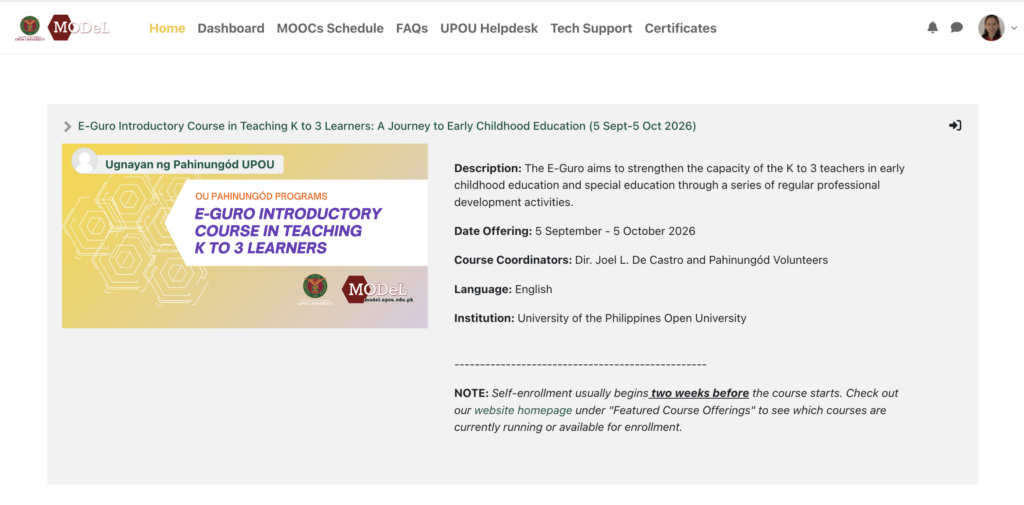
E-Guro Introductory Course in Teaching K to 3 Learners: A Journey to Early Childhood Education on model.upou.edu.ph.
The E-Guro is an online teacher-training program offered through the UPOU’s Massive Open Distance eLearning (MODeL) platform. Designed to address low literacy rates and pandemic-related learning loss among young learners, it aims to upskill Grade K to 3 educators across the Philippines in early literacy, numeracy, early childhood development, and inclusive education practices.
According to UNICEF and the World Bank, 91 percent of 10-year-old Filipino children suffer from “learning poverty”—unable to read or comprehend a simple, age-appropriate story. E-Guro bridges distance through the dedicated service of Pahinungód volunteers—including UP alumni and students. Serving in flexible roles such as course monitors, module writers, and live session facilitators, these volunteers dedicate their time and expertise to strengthen early literacy and numeracy education for young Filipino children. For many of them, participating in E-Guro offers a deeply personal way to stay rooted in service. As alumni volunteer and module writer Joji Reynes-Santos shares, “It provided me with the opportunity to give back to my alma mater as well as be part of a learning community.” Beyond individual contributions, this volunteerism creates a shared space where UP graduates unite around a common purpose—public service Para sa Bayan.
Another Pahinungód alumni volunteer, Genevieve Aguinaldo, reflects, “As alumni volunteers of the Ugnayan ng Pahinungod UPOU, we are able to reignite our connection with the university and the communities that we serve through these kinds of engagements. We are able to meet and be friends with other volunteers who share our commitment to do whatever we can to help Filipino children in their education.”
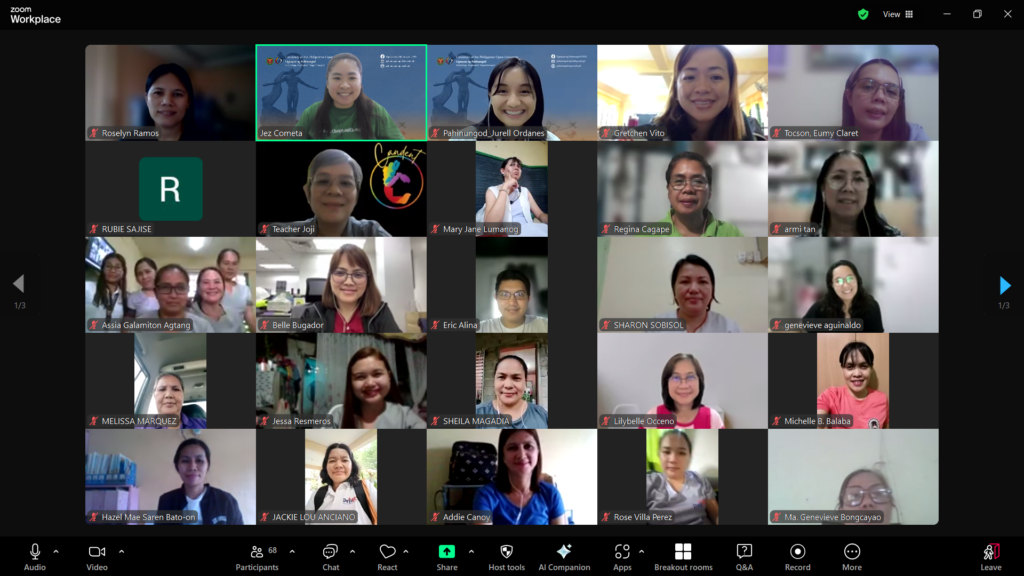
This commitment becomes especially important when engaging directly with educators on the ground. While monitoring a group of Grade K to 3 teachers from Mindanao, Aguinaldo witnessed firsthand the heavy burdens public school teachers face. This includes poor internet access, isolated school locations, and the unavoidable addition of heavy administrative workloads. Describing these educators as “sadly running on low batteries,” the volunteer found that weekly synchronous check-ins became a sanctuary for tired teachers. Reflecting on this, the volunteer describes it as “a very humbling experience” and expresses deep gratitude. “Our interactions in the breakout room of the synchronous sessions allowed them a time of rest and support, which I am thankful to have been given the chance to provide for them.”
Teacher Joji (2nd row, 2nd from left) with the Grades K to 3 Teachers during one of the synchronous check-in sessions. (Photo from Joji Reynes-Santos)
For Grade K to 3 teachers who complete the program as alumni volunteers, the impact of eGuro extends far beyond earning a certificate of completion. Through the course modules and collaborative peer discussions, participating teachers gain a valuable opportunity to step back and critically analyze their own teaching principles and classroom methods. The teachers reported through the volunteer coordinators that the program allows them to review and refine their teaching techniques, reading strategies, and instructional materials based on the practical recommendations offered throughout the modules.
This impact flows both ways: teacher feedback and classroom insights are actively welcomed by course coordinators to continuously update and refine the eGuro modules for future cohorts.
The sense of fulfillment alumni volunteers experience is both immediate and insightful. For Reynes-Santos, seeing teachers apply course suggestions in their own classrooms brings immense joy. “It is always heartwarming when session participants share their insight and express gratitude,” she explains, noting how sessions evolve into lively exchanges of experiences and teaching tips. This fulfillment also creates a ripple effect that inspires others to serve.
After sharing a video about her volunteer journey, Reynes-Santos felt a deep sense of satisfaction when friends and strangers reached out to say they were considering volunteering too. “It was a good feeling when I was messaged or approached by people… just to tell me that they were thinking about volunteering as well because of that video,” she shares.
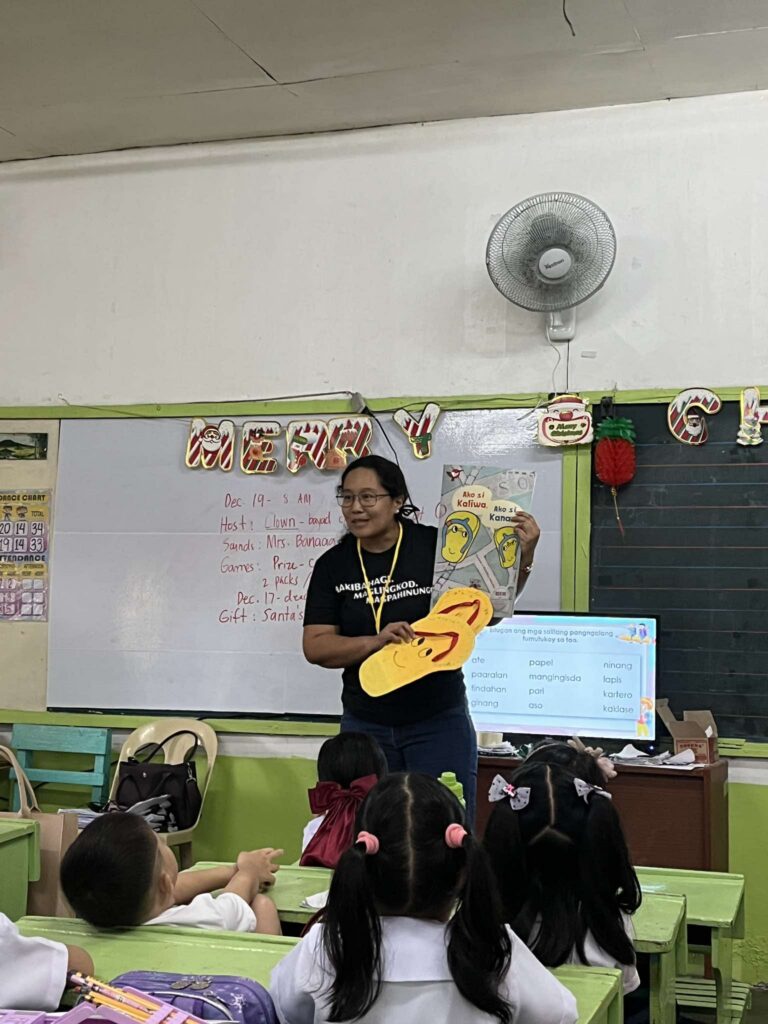
E-Guro alumni volunteer Genevieve Aguinaldo also volunteers for the Bata, Basa Reading Program of the Ugnayan ng Pahinungod UPOU. (Photo from Genevieve Aguinaldo)
Ultimately, the eGuro program proves that giving back requires only a willing heart and a commitment to serve. Through small, sincere acts of volunteerism, UPOU alumni continue to uplift local communities, spark hope in educators, and keep the spirit of Pahinungód alive.