
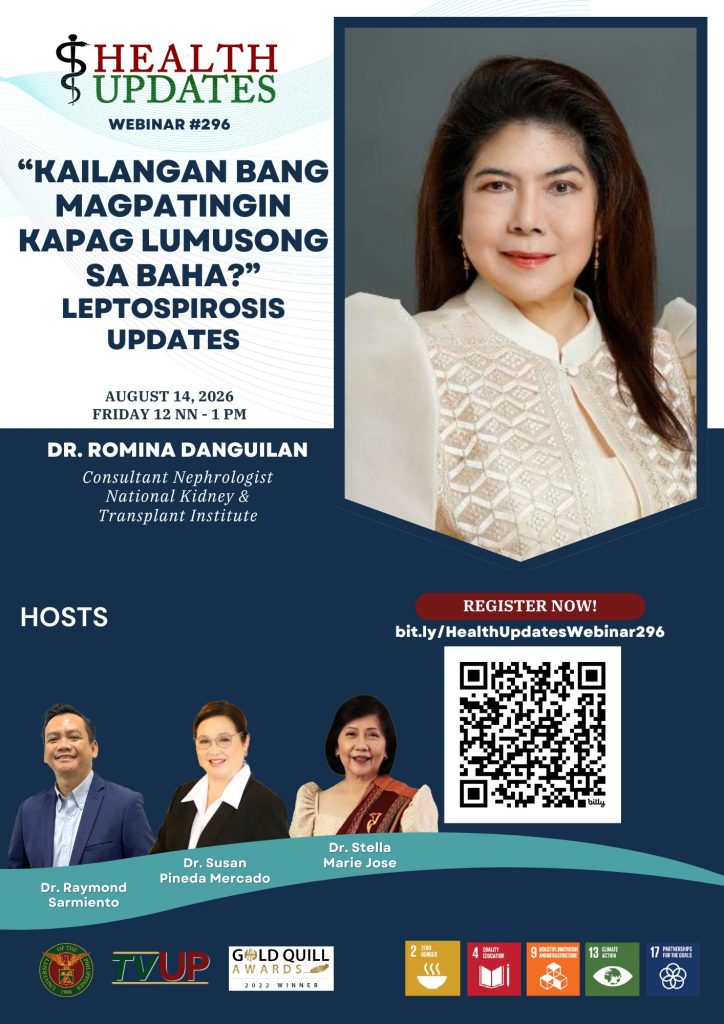
Health UPdates Webinar #296 “Kailangan Bang Magpatingin Kapag Lumusong sa Baha?” Leptospirosis Updates
The University of the Philippines,
in partnership with the UP Manila – National Institutes of Health,
and in cooperation with UP Philippine General Hospital and UP College of Medicine,
would like to invite you to attend this webinar!
Registration slots are limited to this HEALTH UPDATES webinar
So sign up NOW:
bit.ly/HealthUpdatesWebinar296
Webinar #296
August 14, 2026 (Friday), 12:00 noon
Kailangan Bang Mapgpatingin Kapag Lumusong sa Baha?
Leptospirosis Updates
Presenter:
Dr. Romina A. Danguilan
Nephrology Consultant
National Kidney and Transplant Institute (NKTI)
———————————————————–
Webinar #296
August 14, 2026 (Friday), 12:00 noon
Kailangan Bang Mapgpatingin Kapag Lumusong sa Baha?
Leptospirosis Updates
Amid recurring monsoons and heavy urban inundation, wading through floodwaters has shifted from an occasional seasonal hazard to a pervasive public health crisis across the Philippines. A vital question facing clinicians and everyday citizens alike remains deceptive in its simplicity: does mere exposure to floodwater warrant an immediate physician consultation and pharmacological intervention?
Caused by pathogenic spirochetes of the genus Leptospira, which is excreted primarily through the urine of infected animal reservoirs, leptospirosis presents a broad diagnostic spectrum ranging from mild, flu-like anicteric illness to fulminant, life-threatening multi-organ dysfunction. The central clinical challenge lies in distinguishing low-risk dermal exposures from high-risk contacts that can rapidly progress to severe icteric disease, acute kidney injury, or fatal pulmonary hemorrhage syndrome. Navigating post-exposure chemoprophylaxis, particularly the judicious administration of oral doxycycline based on stratified risk profiles, requires refined clinical discernment from general practitioners, vigilant community triage by nurses and pharmacists, and precise laboratory diagnostics from medical technologists.
In this week’s episode, our speaker Dr. Romina A. Danguilan, who is one of the country’s top nephrology experts, will synthesize current national clinical guidelines, practical risk-stratification models, and actionable outpatient algorithms. We will discuss when self-monitoring is safe, when post-exposure antibiotic prophylaxis is strictly indicated, and when subtle red-flag symptoms necessitate emergency transfer for continuous renal replacement therapy. We will attempt to standardize post-flood clinical pathways, prevent life-threatening renal damage, and empower the public with measured, scientific guidance.
Join us in collectively strengthening our diagnostic vigilance and clinical response against one of the region’s most formidable waterborne infections.