
Menu

Husay at Dangal: Rediscovering the UP Oblation and Its Symbols
By Joanna Robles


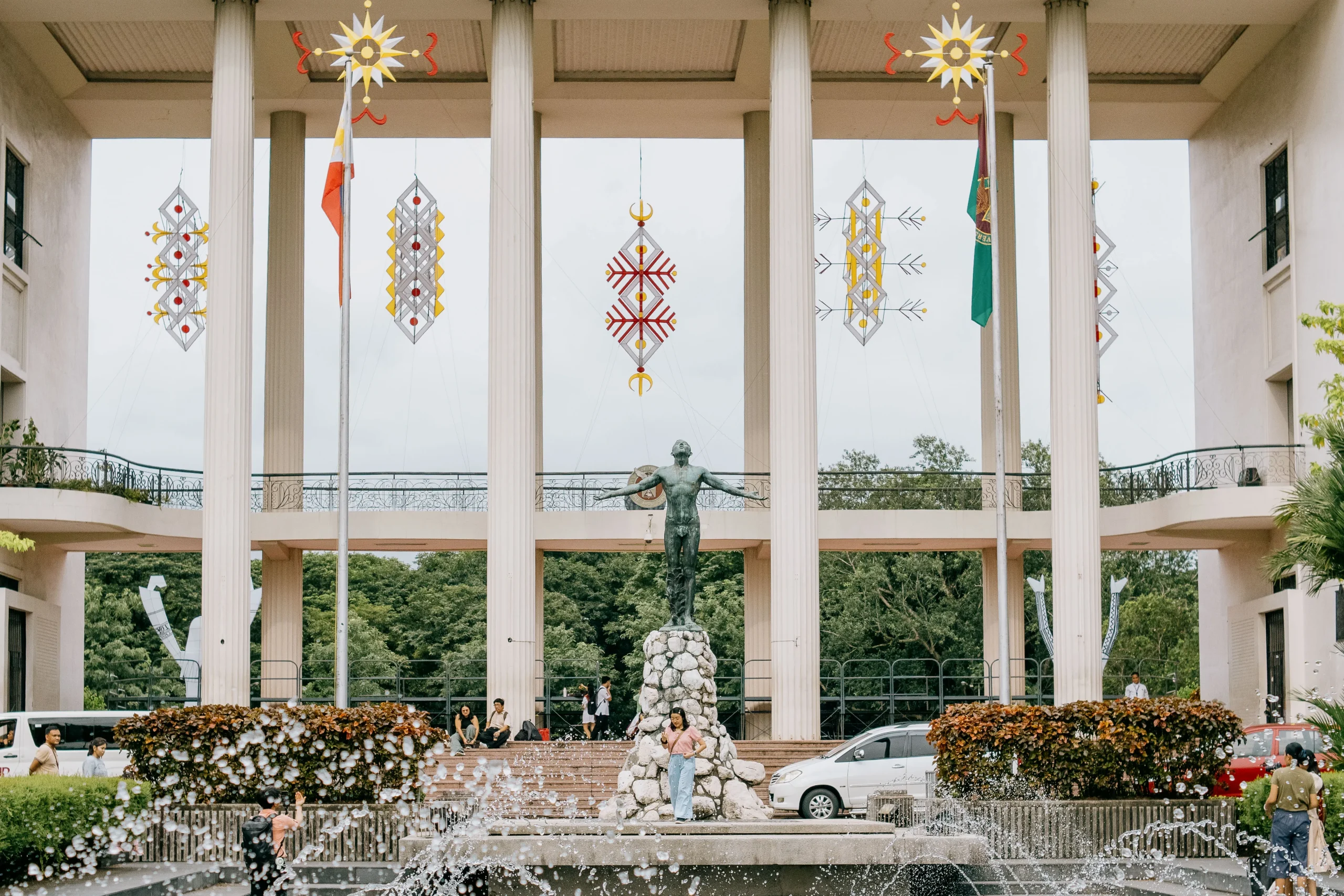
Each year, students, alumni, and visitors gather before the University of the Philippines’ most iconic statue: a man with arms stretched wide, eyes lifted to the sky, body uncovered save for a single leaf.
Known as the Oblation, this sculpture by National Artist Guillermo Tolentino has stood as the enduring symbol of the university’s core values: honor, excellence, and service to the nation.
More than a monument, the Oblation is a living image that continues to reflect the sacrifices, struggles, and ideals of generations of Filipinos.
A Monument Born of Sacrifice
The story of the Oblation began in 1931, when then-UP President Rafael Palma commissioned Tolentino to create a piece that would visually express the university’s highest ideals. Inspired by Dr. José Rizal’s Mi Ultimo Adios, Tolentino envisioned a man offering himself to the country, body, and soul.
The original concrete statue was unveiled on National Heroes Day in 1939 at the UP Manila campus. Standing at 3.5 meters, the statue’s height was intentionally designed by Tolentino to represent the three and a half centuries of Spanish colonial rule, which lasted roughly 333 to 350 years.
Its base features a stylized map of the Philippine archipelago, embedded with rocks from Montalban Gorge, once an area of refuge for Andres Bonifacio and the Katipunan. This grounds the Oblation in the nation’s long history of resistance and struggle for freedom.
In 1949, when UP moved to its new Diliman campus, the statue was relocated, and in 1958, it was recast in bronze in Italy for UP’s Golden Jubilee.
Today, the bronze Oblation stands at the forefront of Quezon Hall, while the original concrete version is preserved inside Gonzales Hall or commonly known as the Main Library.
A Face of the Filipino
The question of who modeled for the Oblation has long sparked curiosity. Some claim it was Fernando Poe Sr., others suggest it was a composite of different figures. But according to official records, Anastacio Caedo, Tolentino’s student assistant, served as the model for the body. The face was based on Fidel Antonio Medalla, a UP medical student.
But Tolentino made a conscious choice not to model the statue after a known hero. Instead, he sought to represent the ordinary Filipino youth, offering themselves in service and sacrifice.
This choice underscores the democratic spirit of the statue: that greatness is not limited to the famous, but lives in the everyday Iskolar ng Bayan who chooses to serve.
While the nudity of the Oblation has always drawn attention, in Tolentino’s vision, the bare figure represented purity of intention and the fullness of one’s sacrifice. However, after consultation with then-UP President Jorge Bocobo, a fig leaf was added to preserve modesty.
Even with this addition, the sculpture remains striking in its vulnerability. It is an image of strength in surrender, and of courage in standing bare before the nation.
Leaves of Meaning
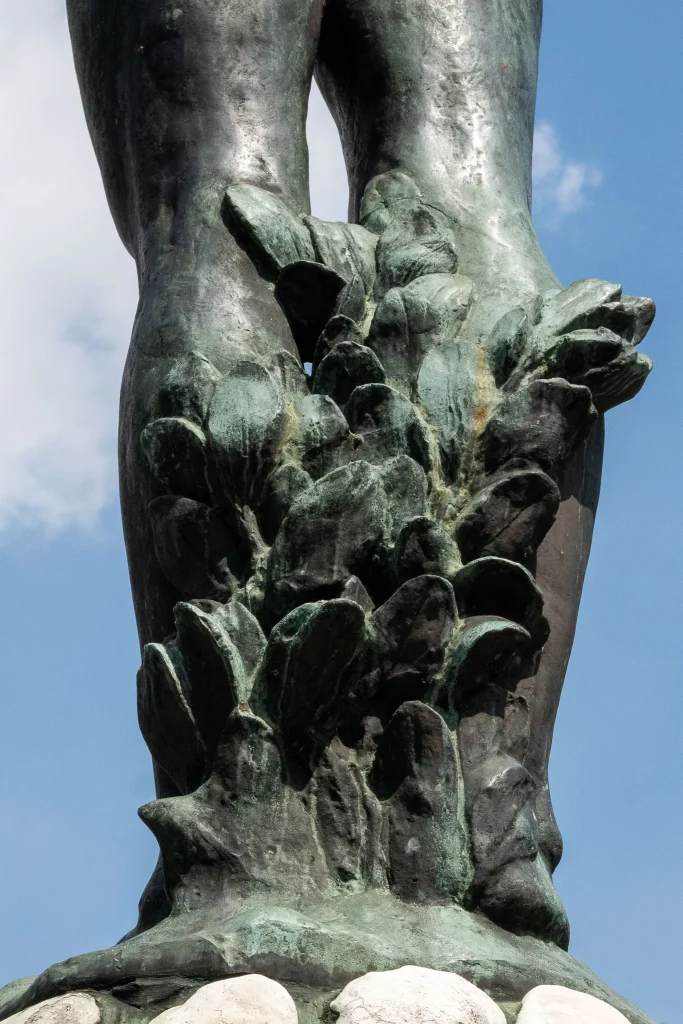
At the base of the Oblation are three plants: katakataka, oliva, and laurel. Far from being decorative, these elements carry deep symbolic meaning.
Katakataka is a plant that thrives in difficult conditions and regenerates easily from a single leaf. In many rural areas, it is known as a healing plant. Its inclusion at the base signifies resilience, regeneration, and the enduring spirit of the Filipino people, particularly in times of crisis.
Oliva (olive leaf), comes from the West, where it stands for peace and reconciliation. Its presence here connects the Filipino struggle for sovereignty with a universal longing for harmony.
Laurel, meanwhile, has long been a symbol of victory and academic achievement. Laurel crowns were worn by Greek poets and Roman emperors; to be “laureled” was to be honored. In the context of the Oblation, it honors the pursuit of academic excellence, not for personal gain, but in service of the nation.
Together, these three leaves ground the Oblation in both cultural and natural symbolism, evoking resilience, harmony, and the honor found in learning.
A Witness of Resistance
The Oblation has stood not just as a university emblem, but as a silent witness to some of the nation’s most turbulent times. During the Marcos dictatorship, the statue was draped in black to mourn the death of democracy.
In more recent years, it has become a rallying point for student protests, academic freedom, and resistance to commercialization.
One of the most visible traditions connected to the statue is the Oblation Run, first organized in 1977 by the Alpha Phi Omega fraternity to promote the banned film Hubad na Bayani. The yearly event, featuring masked students running nude across campus, has since evolved into a form of political action that draws attention to urgent social issues, from corruption to education budget cuts.
The statue, in many ways, continues to reflect the pulse of the times, changing not in form, but in relevance and context.
New Interpretations: Tree of Life Installation
In 2022, during the annual Pag-iilaw lighting ceremony at UP, artist and UP College of Fine Arts Dean Toym Imao created a striking installation titled “Tree of Life” surrounding the Oblation. Drawing inspiration from Mindanaoan and Tausug traditions, the artwork framed the statue within a canopy of katakataka flowers and sunflowers, which are symbols of regeneration and hope.
Imao said the installation was a tribute not just to the Oblation, but to the diverse cultures of the Philippines, and to the countless forms of sacrifice that make up the university’s living history.
For many, the image of the Oblation encircled by blossoms during the night ceremony became an emotional reminder that tradition can evolve with a new meaning.
Revisiting the Symbols We Stand With
In 2023, as UP celebrated its 115th founding anniversary, it reaffirmed its mission through the words: For the Nation. For the People. The Oblation, which has stood through war, dictatorship, pandemics, and change, asks a question that remains urgent: What are we willing to give for our people?
For every UP student, teacher, worker, and graduate, the statue is more than a fixture, it is a mirror. It reflects not perfection, but the commitment to strive, to serve, and to resist. It reminds us that honor and excellence must go hand in hand, not for prestige, but for the betterment of the nation.
In revisiting the Oblation, we do not simply look back. We look forward, renewed by its call, grounded by its meaning, and reminded that true honor lies in giving of oneself, freely, fully, and for others.